



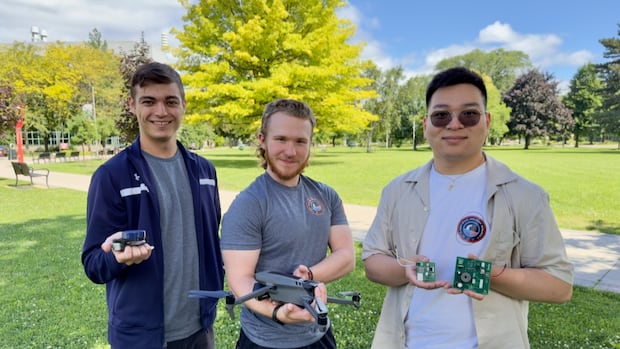
A staff of McMaster College college students in Hamilton will quickly head to Iceland, the place they will camp out by a sequence of underground lava tubes they plan to map with a drone.
The drone makes use of {hardware} and software program designed by the undergraduate college students, who hope their tech will sooner or later be utilized in area exploration, with some modifications, to specifically map underground areas in area.
There are about 25 pupil members of the McMaster Deep-space Analogue Analysis Expedition (DARE) staff. After a yr of planning, 5 of them will go to Iceland for about two weeks in August.
“Being the primary individuals to really create a digital map of those particular caves, that is gonna be actually thrilling,” mentioned Daniel Younger, one of many college students taking the journey.
Michael Holden, the membership’s president, mentioned McMaster DARE is predicated on constructing and testing options to aerospace-related issues, and mapping underground areas is certainly one of them.
“If there is a piece of delicate gear or a bunch of astronauts on one other planet getting into a subterranean cave or any type of crevice, they do not actually know a lot as a result of there is not any straightforward strategy to see in,” mentioned Holden, an engineering physics pupil.
WATCH | See how Canary attaches to a drone:
Michael Holden demonstrates Canary
Michael Holden, a McMaster College pupil and president of the Deep-space Analogue Analysis Expedition staff, demonstrates the drone he and his colleagues will use to map tunnels in Iceland.
The staff’s resolution, referred to as Canary, would be capable of fly in and ship again knowledge on the areas in query, via using sensors. WIth LiDAR (gentle detection and ranging), which measures distances, Canary can even map areas.
“If we will create a system that may go in earlier than [explorers] and inform them areas of curiosity and potential hazards, then they’ve a greater concept of what is in there,” Holden instructed CBC Hamilton, alongside the staff’s co-vice-presidents, Younger and Harry Wu.
“You may consider it slightly bit just like the previous adage ‘canary in a coal mine.’ That is why it is referred to as Canary,” Holden mentioned. “Ship it in beforehand, and it offers them a warning and an concept of what is going on on.”
‘A lot of iteration … a variety of studying’
Holden, Wu, Younger and the 2 different McMaster DARE members will take a look at Canary in Iceland as a result of the lava tubes there are geographically just like caves on the moon or Mars.
 Older variations of McMaster DARE’s circuit boards for Canary, with the most recent model on the fitting. (Justin Chandler/CBC)
Iceland’s geography has made it a preferred website for analog missions, which discuss with experiments in environments just like these in outer area.
The lava tubes that DARE goes to are unnamed, however near an enormous tube referred to as Surtshellir, which is a two-hour journey from Reykjavik, Holden mentioned.
Canary consists of a store-bought quadcopter drone and customized plastic chassis on which {the electrical} elements connect.
Wu, DARE’s electrical lead, confirmed earlier variations of the circuit board the system will use, every smaller and extra streamlined than the final.
“It is a variety of iteration. It is a variety of studying,” Wu mentioned.
WATCH | How Canary creates a map:
Daniel Younger exhibits how his staff’s drone will map tunnels
McMaster Deep-space Analogue Analysis Expedition staff vp Daniel Younger exhibits how their Canary drone will use LiDAR to map areas.
Software program lead Younger confirmed off the LiDAR element utilizing his laptop computer, demonstrating how the sensor tracks the place objects are in relation to it and plots these on a map.
“We are able to type of hint the trail the drone takes after which draw the map that it sees,” the mechatronics pupil mentioned.
Drone examined 1st at Hamilton’s Rattlesnake Level
The DARE group launched beneath a distinct title in 2021. The official McMaster pupil membership has a membership that features college students from a spread of disciplines, comparable to software program engineering and bio-tech, Holden mentioned.
Along with testing Canary, the expedition will embody no less than one aspect venture involving testing soil samples.
To simulate an exploratory mission, the staff will camp by the caves in Iceland. They partnered with a Canadian wilderness first-aid enterprise for coaching and have companions in Iceland who will be capable of help if wanted.
The lava tubes they will map have solely been mapped by hand, Holden mentioned.
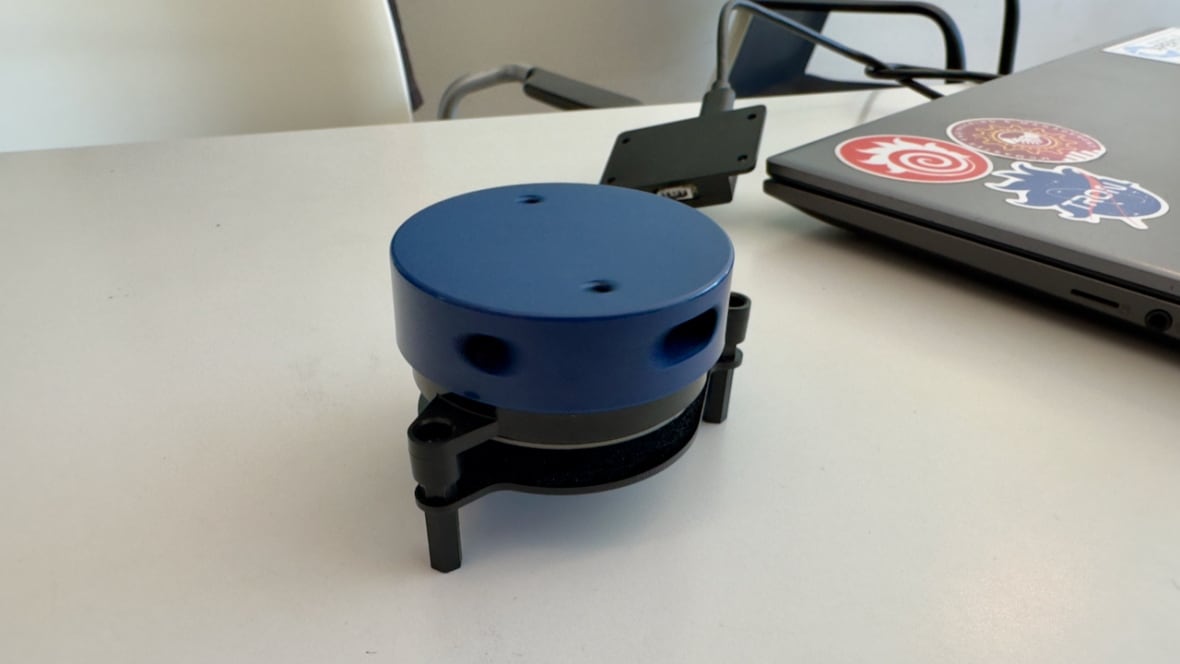 McMaster DARE will use a lidar sensor to map areas utilizing a drone. (Justin Chandler/CBC)
Although the tubes are almost 5½ metres (18 ft) excessive in some locations, Holden mentioned he’ll fly very fastidiously in order to not crash the drone, shifting in deliberate parallel rows as if he had been mowing a garden.
He famous the staff already examined flying within the a lot narrower caves at Hamilton’s Rattlesnake Level.
“There are a few scratches from once we received near partitions earlier than, in order that was enjoyable, however nothing main occurred.”
Holden, Wu and Younger say they’re properly ready for the expedition with a number of redundancies. When requested what they’re most nervous about, all talked about the distant risk of catastrophic failure.
“[If] the half that I made would not work, man, that may kill me,” Wu mentioned. “We’ve spares, however simply the considered all of them having some elementary design error that we missed and solely comes up then is a terrifying thought to me.”
Total, Holden mentioned, pleasure is the prevailing temper.
“Having the ability to be accountable for all of our security methods, our backup plans and seeing all of it come collectively … goes to be nice.”


