





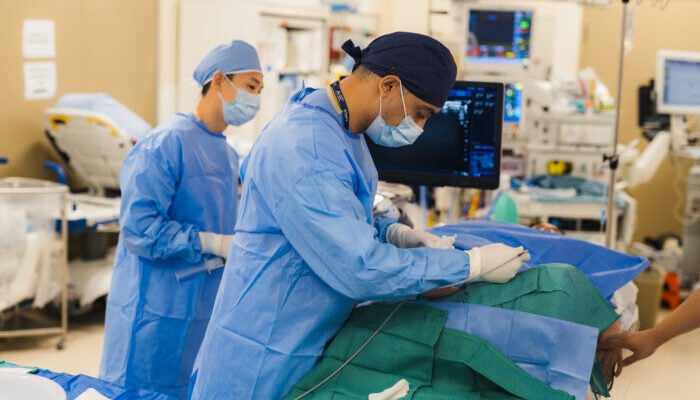
Hamilton General Hospital is the first in Ontario to provide a new treatment aimed at easing severe pain for patients who have undergone amputations. While cryoablation has been around for some time, Hamilton Health Sciences states that the method being applied for post-amputation neuroma pain is innovative.
To date, around 35 patients suffering from post-amputation neuroma pain at Hamilton General Hospital have received this treatment. Neuromas are thickened clusters of nerve tissue that can develop when a nerve is severed.
This procedure boasts nearly an 85 per cent success rate in either eliminating or greatly reducing pain while enhancing daily functions.
“The past two procedures that I’ve had, I have noticed a significant change in my pain scale,” said patient Michelle Bisaillon. “So when I was averaging a seven to eight, I was seeing that I was at like a five or a six. And I’m hoping that with now the third one being done that I can get that down even lower.”
Bisaillon explored various treatments to address her long-standing pain issues. After finally trying cryoablation, she found some relief. She was diagnosed with acute myeloid leukemia at just 14 years old in 2005.
Following her cancer treatments, she developed sepsis and experienced necrosis in her feet. After multiple surgeries, she opted for below-the-knee amputation in 2010 and then required a revision in 2012, which led to the formation of three neuromas.
“They’re really painful to touch,” said Dr. Zain Badar, an interventional radiologist at Hamilton Health Sciences. “So when the amputees wear these prostheses, they start to jab on the neuroma and it causes a significant amount of pain that affects their daily life.”
: Doctor shortage forces Port Colborne urgent care to adjust hours
Bisaillon reports she’s always dealing with pain, regardless of whether she’s using her prosthetic limb or not, which prompted her decision to try cryoablation. This technique employs an extremely cold probe designed to freeze the nerve responsible for sending pain signals from the site of amputation.
The probe is inserted through small incisions instead of making large surgical cuts, allowing most patients to return home on the same day. It’s covered by the Ontario Health Insurance Plan (OHIP) and takes only about 20 minutes.
“It’s being utilized for treating tumors from the kidney, tumors in the liver, tumors in the lung, as well as tumors in the bones,” Badar said. “Dr. Brad, who’s one of our rehab physicians, approached me and she said, ‘Listen, we need to figure out some sort of treatment for our patients because we’re not having great results.’ And I thought about it and I said, ‘You know what, we’ve used cryoablation in a different setting so why don’t we take the same concept and bring it over on this part?’”
Badar mentions it’s already helped many patients carry out their daily tasks without discomfort such as sleeping or grocery shopping.
“Any procedures that we’ve done in the past I usually get a couple of months relief and then we go through the process again,” Bisaillon stated. “The hope with this procedure is that I’ll have a year or two of relief.”
Hamilton Health Sciences has been offering this treatment for almost a year now. Badar notes it’s still early days and they are continuing data collection but expect patients may find relief lasting about a year before needing re-treatment since nerves tend to regenerate.
WATCH MORE: ‘Run for Chris’ raises $40K for Cleghorn Early Intervention Clinic
Source link