




In Canada’s arsenal of attainable responses to a Trump tariff, the nuclear choice is the menace to withhold, scale back or place export tariffs on Canadian vitality.
Already, the mere suggestion of such a tactic has precipitated a {split} between the federal government of Alberta, on one aspect, and the governments of Canada and all different provinces on the opposite.
Tariffs on imports from the U.S. have the potential to trigger ache to sure industries and areas, however Prime Minister Justin Trudeau himself has acknowledged that the impact of Canada’s import tariffs can be diluted by the dimensions of the U.S. inhabitants and economic system.
The withholding or tariffing of Canadian useful resource exports, however, has the potential to trigger actual, generalized discomfort to the U.S. — albeit at nice value to Canada as properly.
“The concept of the menace is hopefully going to do a lot of the heavy lifting,” stated Sanjay Jeram, senior lecturer of political science at Simon Fraser College.
“It is not as if it might’t occur — that we won’t impose both some kind of export tariff on oil and fuel to boost the associated fee, or some form of outright ban,” he informed Ontario Chronicle. “That could possibly be achieved by the federal authorities alone. The Structure does have methods of allowing that.”
However Jeram says Canada’s place has been weakened by the stance taken by Alberta Premier Danielle Smith, which opens the door for the Trump administration to play divide and rule.
“Does that division throughout the nation make it extra seemingly that Trump would see that we could not actually maintain that disunity … and maybe can be extra keen to attend it out?” Jeram stated.
“That is the actual hassle, I believe, within the demonstration of disunity.”
Canada’s strongest card
Nonetheless, there are causes to consider that Canada’s strongest playing cards in a commerce conflict usually are not what it might decline to purchase, however reasonably what it might decline to promote.
Oil will not be the one useful resource card that Canada holds, says Lawrence Herman, a global commerce lawyer and former Canadian diplomat.
“It is most likely the utmost leverage we’ve — the weapon, if you wish to put it that approach, that might have essentially the most influence on the U.S. aspect. However as everyone knows, it’s extremely divisive politically in Canada.
“There are methods, nevertheless, by which this could possibly be achieved,” Herman informed Ontario Chronicle, pointing to Ontario Premier Doug Ford’s willingness to chop off electrical energy exports that many northern states closely rely on.
“Why do not we begin there? With regard to Western Canada and oil and fuel, I believe that’s one thing that we should always point out is on the desk.”
The North American electrical grid sprawls throughout the U.S.-Canadian border in a sequence of ‘interconnections’ that run north-south reasonably than east-west. Many U.S. states rely on energy generated in Canada. (Iowa State College)
Herman factors out that except the U.S. exempts crude oil from any normal tariff on Canadian imports, Canadian motion can be moot anyway.
“We do not have to even take into consideration [crude] export restraints or export restrictions in that context,” he stated.
Herman says tariffs on potash, essential minerals, metal and aluminum would additionally put strain on the brand new administration.
“These are issues that U.S. industries built-in with Canadian producers have come to depend on.”
Worth of fuel extra essential than value of eggs
Whereas the icon of inflationary discontent within the latest U.S. election was the worth of eggs, the worth that has lengthy been thought of essentially the most “seen” and politically influential is the worth of fuel on the pumps.
Researchers at Stanford College tracked 30 years of polling and located {that a} U.S. president, on common, loses 0.6 per cent of approval for every dime of enhance in a gallon of fuel.
That impact continued to the 2024 election, with three of each 10 battleground-state voters citing fuel costs as their prime precedence. When fuel costs rise, client confidence falls, as does the proportion of voters who say the nation is heading in the right direction.
 Research have proven {that a} rise in fuel costs take a success to presidential reputation. (David Zalubowski/AP)
All of that signifies that Canada might doubtlessly put a political squeeze on a Trump administration that enters workplace with skinny Congressional majorities, and is already excited about the 2026 midterms.
A key query is whether or not Canada has the leverage to extend prices to U.S. customers sufficient to make them howl to their elected representatives. Might refiners not merely change Canadian imports with crude from different nations?
To reply that query, it is essential to know how the U.S. refining business got here to depend on Canadian crude within the first place.
A mismatch of oilfields and refineries
A key truth is that, whereas the nation is weak to a cutoff of Canadian oil, that is not as a result of it would not produce sufficient oil for its personal wants. It produces greater than it wants, and is a internet exporter.
The issue for the U.S. arises in terms of turning all that crude oil manufacturing into usable gasoline, diesel and jet gas.
There are about 130 refineries within the U.S., able to refining over 18 million barrels of oil a day, however there’s a mismatch between these refineries and the form of oil the U.S. produces.
Again within the Eighties and ’90s, there have been widespread fears that oil was operating out. U.S. manufacturing was falling, and so the refining business redesigned itself to have the ability to course of Latin American oil, coming principally from Venezuela.
 American oil refiners are largely outfitted to deal with heavier crude imported from different nations akin to Canada. (Bing Guan/Reuters)
Venezuela has the world’s largest recognized oil reserves, a lot of it bitumen-heavy crude that’s exhausting to refine and exhausting to drive by a pipeline except diluted, similar to the oil in Alberta’s oilsands.
Then within the early a part of this century, new applied sciences akin to horizontal drilling precipitated a U.S. oil increase in Texas fields such because the Permian and Eagle Ford, and in North Dakota’s Bakken. The “shale oil” produced in these fields is lighter and “sweeter” (much less sulphurous) than Venezuelan or Canadian crude, and subsequently theoretically simpler to refine.
However many refineries had already invested in costly applied sciences designed to deal with heavy crude, and their enterprise mannequin relied on the worth low cost that they demand for such oil, which sells for a number of {dollars} lower than a barrel of sunshine, candy crude.
Consequently, a lot of that U.S. shale oil started to be exported to refineries abroad that had been higher suited to deal with it. U.S. crude oil exports have soared from lower than 1,000,000 barrels a month in 2009 to properly over 100 million barrels a month right now, whereas the U.S. has continued to import overseas heavy oil.
Venezuela out, Canada in
The rise of the Chavez regime in Venezuela in 1999, which precipitated an exodus of petroleum engineers and a steep fall in oil manufacturing, set again the U.S. refining business’s long-term plans. Happily, Canadian oilsands manufacturing was ramping up on the identical time Venezuela’s was declining.
The following quarter-century would see a proliferation of pipelines and transportation networks designed to refine heavy Canadian crude within the U.S. Many Midwestern and western refineries particularly rely solely on Canadian imports.
Had been Canada to shut or tighten the faucets, or just enhance the worth, these refineries might theoretically supply comparable heavy oil from different suppliers. However in apply, each political and financial concerns would make that tough.
In November 2022, the U.S. authorities eased sanctions on Venezuela, and Chevron returned to the nation. However that leisure was contingent on Nicolas Maduro permitting democratic elections. The Biden administration started to withdraw licenses in 2024 because it grew to become obvious that Maduro didn’t intend to permit a free and truthful vote and right now, little oil is flowing.
Donald Trump might doubtlessly raise sanctions altogether, permitting Venezuelan crude to circulation as soon as once more to U.S. refineries. However there’s motive to consider he will not do this.
As a Florida resident, Trump understands the significance of “MAGA-zuelans” and different anti-communist Latino voters to his profitable coalition within the state. It is exhausting to think about Trump’s incoming secretary of state, Cuban-American Marco Rubio, would wish to start his tenure by lifting sanctions on the Maduro regime.
And in any case, Venezuela’s ramshackle business is only a shadow of what it was earlier than the socialist takeover — producing fewer than 1,000,000 barrels a day complete, a lot of which is already promised to China. It might by no means change the 4 million barrels a day Canada exports to the nation.
No viable alternate options
Colombian heavy bitter Castilla oil, or Mexican heavy bitter Maya, will be refined in the identical crops that deal with Western Canadian crude.
However Colombian manufacturing simply is not large enough, and Mexico is transferring ahead with a strategic plan to refine its heavy crude in its personal crops.
That leaves sources like Russia and Iraq, each of which produce heavy crude. However whereas Trump is perhaps solely too pleased to raise the worth cap imposed on Russian oil as a punishment for the invasion of Ukraine, these nations undergo from one other drawback, one which impacts all non-Canadian suppliers: the right way to get their oil to the U.S. refineries that may deal with them.
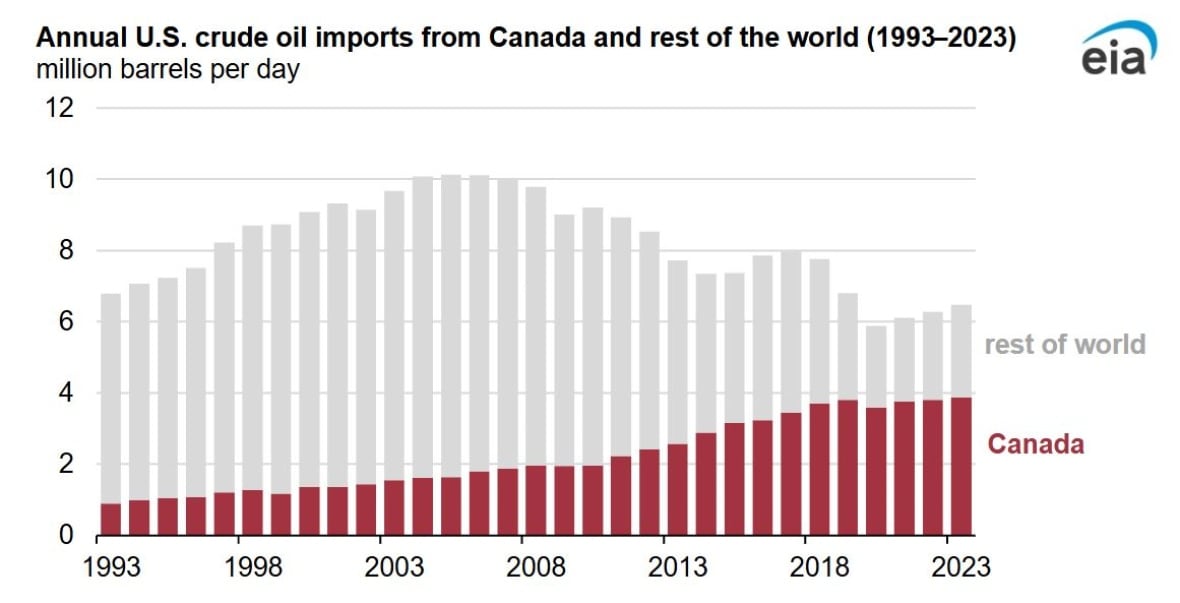 Even because the U.S. has produced extra of its personal oil, and imported much less total, it has grow to be extra depending on imports from Canada. (U.S. Power Info Administration)
Whereas Gulf Coast refineries — extra accessible to seaborne tankers — do deal with some Canadian crude, the refineries that actually rely on Canadian imports are within the landlocked Midwest and Rocky Mountain states. They’re deeply related to Canadian oilfields by a set community of multi-billion-dollar pipelines that merely do not connect with Russia, Venezuela or Iraq.
Retooling not a great choice
However might U.S. refineries not merely retool in an effort to deal with the sunshine crude that is coming from their very own shale oilfields? Could not they cease importing crude from Canada, and cease sending their very own home crude to refineries in Mexico, China and the Netherlands?
They may, however the associated fee can be extraordinarily excessive, and the transportation issues — although not as insurmountable as they might be sourcing crude abroad — would nonetheless be extreme.
Such a retooling would additionally take time, and certain not present outcomes till lengthy after the subsequent U.S. midterms, so it might do little to stave off the political influence of Canadian motion.
Additionally, many within the business consider the height of the U.S. shale oil increase is now handed. Few would want to spend lots of of thousands and thousands retooling for a useful resource that’s changing into scarcer, solely to need to do it over again once they inevitably return to processing heavy oil.
 U.S. oil manufacturing was in a protracted decline when a lot of its trendy refineries had been constructed. The shale oil increase that started within the 2000s precipitated it to rise once more, however many refineries cannot deal with that form of crude oil. (U.S. Power Info Administration)
Questions stay, although. An enormous one is: who would find yourself having to eat these losses? Wouldn’t it be the U.S. refiners themselves? Would they move on all the prices to the American client, because the Canadian authorities would hope? Or would they drive the Canadian suppliers to decrease their costs, since Canadian producers are additionally hostages of the identical mounted transportation community, and would wrestle to seek out different markets?
Some analysts consider that every one three would find yourself sharing the associated fee, and previous expertise has proven {that a} 20 per cent enhance in value on the refinery degree sometimes interprets to a couple of 10 per cent enhance on the retail pumps.
All of these concerns are at play as Canadian politicians ponder their nuclear choice, together with the considerations about nationwide unity.
However though the associated fee can be excessive, says Herman, the menace ought to keep on the desk.
“Trump is threatening the Canadian economic system and Canadian livelihood, and in impact threatening Canada as a rustic. And we’ve to reply accordingly,” he stated.
“It’s totally exhausting to orchestrate one thing the place the ache or the difficulties are felt equally throughout the nation. Some areas, some sectors, could really feel the ache greater than others. However as Doug Ford rightly stated, we have to cope with this as a nationwide matter, as one thing that impacts Canada as a complete.”


