



Inuit leaders returning from a recent visit to Greenland point out a major difference in infrastructure between that Nordic nation and Canada’s North. They are urging the federal government to take immediate action as part of its increased focus on Arctic security.
“They’re way ahead of us,” said Paul Irngaut, president of Nunavut Tunngavik Incorporated (NTI), which represents Inuit in the territory.
“We’re the last people that the government thinks about until now because of the political climate.”
Irngaut was part of an Inuit delegation that went to Nuuk last week for the opening ceremony of the Canadian Consulate, showing unity against U. S. President Donald Trump’s takeover threats.
This wasn’t Irngaut’s first trip to Greenland’s capital.
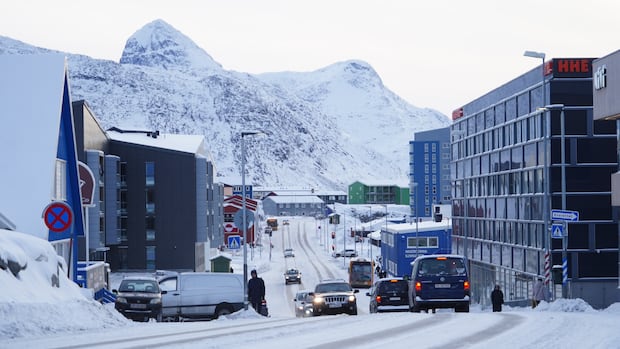
![]() Downtown Nuuk has gone through a significant modernization over the past decade. (Charles Contant/CBC)
The NTI president mentioned he visited three years ago to check out the University of Greenland (Ilisimatusarfik) and explore how Inuit in Canada could establish their own university.
“What we want to see here in Nunavut is a building like that,” Irngaut said.
The university serves as just one example among many advancements in Greenland that Inuit leaders feel are necessary for Canada as the federal government plans to invest tens of billions in defense and Arctic security over coming years.
Downtown Nuuk has gone through a significant modernization over the past decade. (Charles Contant/CBC)
The NTI president mentioned he visited three years ago to check out the University of Greenland (Ilisimatusarfik) and explore how Inuit in Canada could establish their own university.
“What we want to see here in Nunavut is a building like that,” Irngaut said.
The university serves as just one example among many advancements in Greenland that Inuit leaders feel are necessary for Canada as the federal government plans to invest tens of billions in defense and Arctic security over coming years.
![]() Chelsea Uppahuak-Prusky, 21, says an Inuit-led university in her home community of Arviat, Nunavut, will transform lives. (Olivia Stefanovich/CBC)
Apart from infrastructure needs, Greenland’s education system teaches post-secondary students primarily in Kalaallisut, the language spoken by Greenlandic Inuit.
This stands in contrast with Inuktitut not being used as a primary language for most students within their homeland across Nunangat.
“Those are all things that we wish for here in Canada,” said Natan Obed, president of Inuit Tapiriit Kanatami (ITK), representing national advocacy for Canadian Inuit.
“We do hope at this time when there’s more focus on the Arctic that the Canadian government doesn’t only think about militarization and building what’s needed for fighter jets and warships but also considers stability and sustainability for our communities.”
Chelsea Uppahuak-Prusky, 21, says an Inuit-led university in her home community of Arviat, Nunavut, will transform lives. (Olivia Stefanovich/CBC)
Apart from infrastructure needs, Greenland’s education system teaches post-secondary students primarily in Kalaallisut, the language spoken by Greenlandic Inuit.
This stands in contrast with Inuktitut not being used as a primary language for most students within their homeland across Nunangat.
“Those are all things that we wish for here in Canada,” said Natan Obed, president of Inuit Tapiriit Kanatami (ITK), representing national advocacy for Canadian Inuit.
“We do hope at this time when there’s more focus on the Arctic that the Canadian government doesn’t only think about militarization and building what’s needed for fighter jets and warships but also considers stability and sustainability for our communities.”
 Prusky understands firsthand what that’s like since he and his sister Chelsea both attend Nunavut Sivuniksavut College located all way down south Ottawa.
“It was such a huge jump,” his sister shared. “I hated taking those three hours flight from [Iqaluit] up north down south toward Ottawa – just stepping out my comfort zone took tons courage.”
They plan on applying when it opens around 2030-whether as students or staff members.
“Never thought I’d see it become possible,” she added excitedly , “Opportunity arising means everything future generations.”
Currently Yukon hosts Canada’s lone Arctic-region university outside boundaries defined by those residing within designated areas known collectively named “Inuit Nunangat”.
Irngaut believes investing into establishing an indigenous-run facility providing housing along critical services would affirm sovereignty claims made regarding ownership rights over territories lying above tree lines across northern landscapes dotted throughout vast expanses alongside icy oceans.
“Canada shows concern towards its indigenous population,” Irngaut concluded,” demonstrating commitment toward youth while promoting educational attainment amongst groups traditionally marginalized.”
Prusky understands firsthand what that’s like since he and his sister Chelsea both attend Nunavut Sivuniksavut College located all way down south Ottawa.
“It was such a huge jump,” his sister shared. “I hated taking those three hours flight from [Iqaluit] up north down south toward Ottawa – just stepping out my comfort zone took tons courage.”
They plan on applying when it opens around 2030-whether as students or staff members.
“Never thought I’d see it become possible,” she added excitedly , “Opportunity arising means everything future generations.”
Currently Yukon hosts Canada’s lone Arctic-region university outside boundaries defined by those residing within designated areas known collectively named “Inuit Nunangat”.
Irngaut believes investing into establishing an indigenous-run facility providing housing along critical services would affirm sovereignty claims made regarding ownership rights over territories lying above tree lines across northern landscapes dotted throughout vast expanses alongside icy oceans.
“Canada shows concern towards its indigenous population,” Irngaut concluded,” demonstrating commitment toward youth while promoting educational attainment amongst groups traditionally marginalized.”
Source link
Stability and sustainability
All communities within Inuit Nunangat, Canada’s Inuit homeland, rely on diesel power except for Inukjuak, Que., which is moving toward hydro power. Most communities in Greenland already utilize hydro energy. There’s only one deepwater port in Inuit Nunangat, located at Iqaluit, which faces more challenges due to seasonal ice compared with Nuuk’s deepwater port that can handle cargo more efficiently than any ports in Canada’s Arctic regions.Federal funding for Inuit-led university
This week ITK announced Arviat will be home to a new university campus serving all regions within Inuit Nunangat. Inuit leaders are still waiting on a commitment from Ottawa regarding funding for this initiative along with legislation allowing it to function across multiple areas including Nunavut, Northwest Territories, northern Quebec and Labrador. Youth from Arviat told how much impact they believe this university will have on everyone living there. “It will open a lot of doors because I know it’s hard for a lot of Inuit to move from their homes thousands of kilometres away just to go to school,” said Tyson Prusky, 19 years old originally from Arviat............ Prusky understands firsthand what that’s like since he and his sister Chelsea both attend Nunavut Sivuniksavut College located all way down south Ottawa.
“It was such a huge jump,” his sister shared. “I hated taking those three hours flight from [Iqaluit] up north down south toward Ottawa – just stepping out my comfort zone took tons courage.”
They plan on applying when it opens around 2030-whether as students or staff members.
“Never thought I’d see it become possible,” she added excitedly , “Opportunity arising means everything future generations.”
Currently Yukon hosts Canada’s lone Arctic-region university outside boundaries defined by those residing within designated areas known collectively named “Inuit Nunangat”.
Irngaut believes investing into establishing an indigenous-run facility providing housing along critical services would affirm sovereignty claims made regarding ownership rights over territories lying above tree lines across northern landscapes dotted throughout vast expanses alongside icy oceans.
“Canada shows concern towards its indigenous population,” Irngaut concluded,” demonstrating commitment toward youth while promoting educational attainment amongst groups traditionally marginalized.”
Prusky understands firsthand what that’s like since he and his sister Chelsea both attend Nunavut Sivuniksavut College located all way down south Ottawa.
“It was such a huge jump,” his sister shared. “I hated taking those three hours flight from [Iqaluit] up north down south toward Ottawa – just stepping out my comfort zone took tons courage.”
They plan on applying when it opens around 2030-whether as students or staff members.
“Never thought I’d see it become possible,” she added excitedly , “Opportunity arising means everything future generations.”
Currently Yukon hosts Canada’s lone Arctic-region university outside boundaries defined by those residing within designated areas known collectively named “Inuit Nunangat”.
Irngaut believes investing into establishing an indigenous-run facility providing housing along critical services would affirm sovereignty claims made regarding ownership rights over territories lying above tree lines across northern landscapes dotted throughout vast expanses alongside icy oceans.
“Canada shows concern towards its indigenous population,” Irngaut concluded,” demonstrating commitment toward youth while promoting educational attainment amongst groups traditionally marginalized.”Source link


