



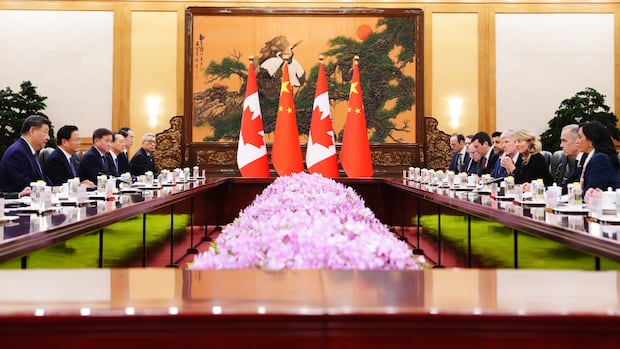
The federal government reached what Prime Minister Mark Carney is calling a “landmark” agreement with China on Friday. “It’s a partnership that reflects the world as it is today, with an engagement that is realistic, respectful and interest-based,” Carney told a news conference in Beijing. The deal comes after a decade of tense relations between the two countries. Here’s a breakdown of what’s in the deal, how the two countries arrived at this point and how key players are reacting.
What are the details of the agreement?
It is still fairly early into the deal, but the two countries have essentially agreed to lift or lower tariffs on certain products. The Canadian government has agreed to allow 49,000 Chinese electric vehicles into the market at a tariff rate of 6.1 per cent — a measure that had been in place before Ottawa put a 100 per cent tariff on all Chinese EVs in 2024. In exchange, Carney says he expects China to lower tariffs on Canadian canola to 15 per cent by March. Beijing will also remove tariffs on Canadian canola meal, lobsters, crab and peas as of March until at least the end of 2026. Carney’s team also told Canada’s premiers during a briefing call on Friday that the two sides had made progress to resolve issues around Canadian pork exports, according to sources with knowledge of the call. But Chinese tariffs on pork remain in place. WATCH | Canada reaches deal with China on EVs, canola: Canada reaches tariff deal with China on EVs, canola Prime Minister Mark Carney says Canada has reached a deal with China to allow tens of thousands of Chinese electric vehicles into the country at a lower tariff rate in exchange for lower duties on canola, lobsters, crabs and peas.How did we get here?
Although China has hit Canada with canola and other agricultural tariffs in the past — specifically during the Meng Wanzhou extradition trial — the latest tariff spat began a little over a year ago. Then-prime minister Justin Trudeau announced Canada would slap a 100 per cent tariff on Chinese electric vehicles in the summer of 2024. The move mimicked a similar initiative by the U.S. Both countries cited concerns about the prospect of Chinese automakers flooding North America with heavily subsidized cars made in a country with poor labour and environmental standards. China responded to Canada’s move by launching an anti-dumping investigation of Canadian canola imports. In March 2025, Beijing put a 100 per cent tariff on Canadian canola oil, canola meal and peas — as well as 25 per cent tariffs on pork and seafood products. In August, China slapped a 76 per cent tariff on Canadian canola seed. WATCH | Canola deal surprises crop producers: Canola deal surprises ‘cautiously optimistic’ Sask. crop producers
They weren’t expecting a trade pact between Canada and China, but are happy to see some tariff relief. Agricultural Producers Association of Saskatchewan president Bill Prybylski reacts to Friday morning’s announcement.
Carney, who took over for Trudeau in March 2025, met Chinese President Xi Jinping on the sidelines of the Asia Pacific Economic Co-operation summit in South Korea in October.
The October meeting was the first official meeting between the two heads of government since 2017. Carney called it a “turning point” in Canada-China relations and talks about the importance of forging new partnerships as the U.S. upends global trade.
The prime minister arrived in China earlier this week for a series of meetings, including with Xi.
Canola deal surprises ‘cautiously optimistic’ Sask. crop producers
They weren’t expecting a trade pact between Canada and China, but are happy to see some tariff relief. Agricultural Producers Association of Saskatchewan president Bill Prybylski reacts to Friday morning’s announcement.
Carney, who took over for Trudeau in March 2025, met Chinese President Xi Jinping on the sidelines of the Asia Pacific Economic Co-operation summit in South Korea in October.
The October meeting was the first official meeting between the two heads of government since 2017. Carney called it a “turning point” in Canada-China relations and talks about the importance of forging new partnerships as the U.S. upends global trade.
The prime minister arrived in China earlier this week for a series of meetings, including with Xi.
Could the deal aggravate the U.S. ahead of the CUSMA review?
Eyes are on the White House to see how Washington will react now that the Canada-China deal has been reached. Canada placed the tariffs on Chinese EVs in lockstep after the U.S. implemented a nearly identical policy. Ottawa and Washington cited concerns about China possibly flooding North America with heavily subsidized cars. Both countries — with Mexico — are set to review the Canada-U.S.-Mexico Agreement (CUSMA) later this year. Trump so far appears unfazed by the Canada-China deal, even saying on Friday that it’s a “good thing.” WATCH | Carney says relationship with China more predictable than U.S.: Canada’s relationship with China ‘more predictable’ than relationship with U.S., PM says
Prime Minister Mark Carney, speaking to reporters in Beijing on Friday after making a preliminary deal with China on a range of issues, said Canada’s relationship with the U.S. is ‘more multi-faceted’ and much deeper than Canada’s relationship with China — but noted that ties with China have become more predictable in recent months.
“That’s what [Carney] should be doing. It’s a good thing for him to sign a trade deal. If you can get a deal with China, you should do that,” Trump told reporters at the White House.
During a Tuesday meeting at the Detroit Economic Club, Trump reportedly said he’d be open to Chinese companies building plants in U.S. towns — as long as they create jobs for Americans.
But one of the president’s advisers doesn’t seem pleased with the idea of Canada’s deal with China. U.S. Trade Representative Jamieson Greer signalled earlier in the week that he thinks Canada would regret making such a deal.
“I think it’s problematic for Canada,” Greer told CNBC on Thursday. “There’s a reason why we don’t sell a lot of Chinese cars in the United States. It’s because we have tariffs to protect American auto workers and Americans from those vehicles.”
Canada’s relationship with China ‘more predictable’ than relationship with U.S., PM says
Prime Minister Mark Carney, speaking to reporters in Beijing on Friday after making a preliminary deal with China on a range of issues, said Canada’s relationship with the U.S. is ‘more multi-faceted’ and much deeper than Canada’s relationship with China — but noted that ties with China have become more predictable in recent months.
“That’s what [Carney] should be doing. It’s a good thing for him to sign a trade deal. If you can get a deal with China, you should do that,” Trump told reporters at the White House.
During a Tuesday meeting at the Detroit Economic Club, Trump reportedly said he’d be open to Chinese companies building plants in U.S. towns — as long as they create jobs for Americans.
But one of the president’s advisers doesn’t seem pleased with the idea of Canada’s deal with China. U.S. Trade Representative Jamieson Greer signalled earlier in the week that he thinks Canada would regret making such a deal.
“I think it’s problematic for Canada,” Greer told CNBC on Thursday. “There’s a reason why we don’t sell a lot of Chinese cars in the United States. It’s because we have tariffs to protect American auto workers and Americans from those vehicles.”
Premiers weigh in
Reactions from Canada’s premiers have been mixed. Saskatchewan Premier Scott Moe — who joined Carney on his trip to China — characterized Friday’s deal as a “positive step forward.” “[It’s] a very positive day for Canada-China relations. A positive day for the agriculture industry in Canada and I think credit goes to the prime minister,” Moe told Adam Hunter, host of CBC Radio’s The Morning Edition. Saskatchewan is the largest canola-producing province in Canada, followed by Alberta and Manitoba. WATCH | Sask. premier and canola producers react to China deal: Sask. premier and producers react to the new trade agreement with China
Ottawa has a deal with Beijing that relieves some duties on Canadian canola. In exchange, Canada will let China import tens of thousands of electric vehicles.
“We’ve been asking in Western Canada, certainly our government here in Manitoba, for an off-ramp for these canola tariffs. So to see some progress here is welcome news,” Manitoba Premier Wab Kinew told reporters on Friday.
But over in Ontario, the hub of Canada’s auto industry, the deal was met with less enthusiasm. Premier Doug Ford blasted the deal, which he said would allow “Chinese subsidized spy cars” into Canada.
“We’re letting China into a market that’s going to have lower tariffs than our largest market, the U.S., and I don’t think that’s going to go over too well with President Trump,” Ford said.
WATCH | Premier Ford says China deal will be terrible for auto sector:
Sask. premier and producers react to the new trade agreement with China
Ottawa has a deal with Beijing that relieves some duties on Canadian canola. In exchange, Canada will let China import tens of thousands of electric vehicles.
“We’ve been asking in Western Canada, certainly our government here in Manitoba, for an off-ramp for these canola tariffs. So to see some progress here is welcome news,” Manitoba Premier Wab Kinew told reporters on Friday.
But over in Ontario, the hub of Canada’s auto industry, the deal was met with less enthusiasm. Premier Doug Ford blasted the deal, which he said would allow “Chinese subsidized spy cars” into Canada.
“We’re letting China into a market that’s going to have lower tariffs than our largest market, the U.S., and I don’t think that’s going to go over too well with President Trump,” Ford said.
WATCH | Premier Ford says China deal will be terrible for auto sector: Ford says EV deal with China ‘is going to be terrible’ for Ontarians, auto sector
Ontario Premier Doug Ford says he did not hear from Prime Minister Mark Carney about the electric vehicle arrangement with China before it was announced, adding ‘this was not thought out properly.’
“It’s going to hurt every single auto manufacturer, every single supply chain that has anything to do with the auto sector. This was not thought of properly, it wasn’t consulted, it was a knee-jerk reaction as far as I’m concerned, and this is going to be a big, big problem.”
Sources with knowledge of the prime minister’s briefing call with the premiers told that Ottawa intends to bring forward broader support for the auto industry in the coming weeks.
Ford says EV deal with China ‘is going to be terrible’ for Ontarians, auto sector
Ontario Premier Doug Ford says he did not hear from Prime Minister Mark Carney about the electric vehicle arrangement with China before it was announced, adding ‘this was not thought out properly.’
“It’s going to hurt every single auto manufacturer, every single supply chain that has anything to do with the auto sector. This was not thought of properly, it wasn’t consulted, it was a knee-jerk reaction as far as I’m concerned, and this is going to be a big, big problem.”
Sources with knowledge of the prime minister’s briefing call with the premiers told that Ottawa intends to bring forward broader support for the auto industry in the coming weeks.
Farmers praise it, auto industry pans it
Like the premiers, industry players have reacted differently to the deal. Like Moe, Andre Harpe, chair of the Canadian Canola Growers Association, said the deal is “very good news.” “Industry and farmers were looking for this news… it’s going to take some of the uncertainty away. It’s going to bring some certainty to the industry,” Harpe said. On the flipside, the auto industry is expressing concerns over the agreement. “We have been clear that any sort of engagement with China on electric vehicles would be extremely risky at this period,” said Brian Kingston, president of the Canadian Vehicle Manufacturers’ Association. “The Canadian economy, the automotive industry, is deeply integrated with the United States. Securing a renewal of our trilateral trade agreement has to be the top priority, and engaging further with China at this time is putting that at risk.” Flavio Volpe, president of the Automotive Parts Manufacturers’ Association and a member of the Prime Minister’s Council on Canada-U.S. Relations, said he wants to see some “guardrails” on the China deal. “Three-year review. Hard cap on those imports. And, of course, any of those vehicles have to meet Canadian safety standards,” Volpe said. Unifor, Canada’s largest private-sector union, panned the new agreement. “This is a self-inflicted wound to an already injured Canadian auto industry,” president Lana Payne said in a statement. “Providing a foothold to cheap Chinese EVs, backed by massive state subsidies, overproduction and designed to expand market share through exports, puts Canadian auto jobs at risk while rewarding labour violations and unfair trade practices.”Source link


