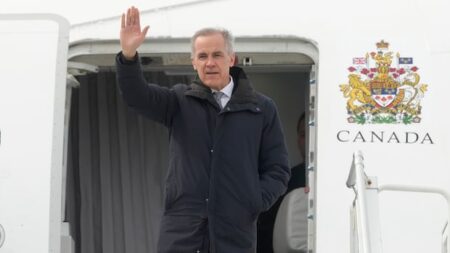




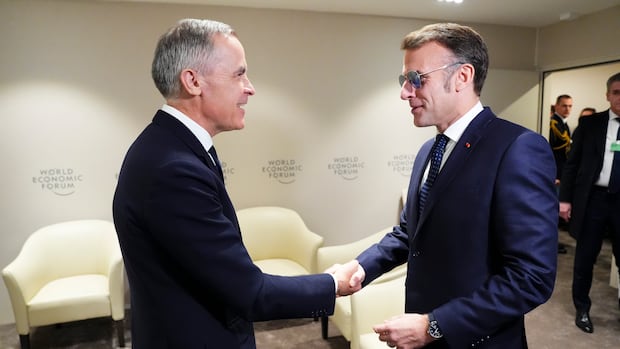
A subtle movement is happening in Europe where some of Canada’s closest allies are looking to take cover under France’s small but effective nuclear shield.
This initiative from French President Emmanuel Macron, who has labeled the next 50 years as the “era of nuclear weapons,” aims – at least on paper – to add an extra layer of deterrence to NATO’s U. S.-backed security measures.
Once again – theoretically – Russia is seen as the threat that needs addressing.
However, with U. S. President Donald Trump once again criticizing NATO allies for not supporting his military actions in the Middle East and a striking – though not unexpected – report from the Financial Times that Denmark was gearing up to defend Greenland against potential American annexation, we see a new perspective on France’s advanced nuclear deterrent strategy.
Should Canada join this movement?
WATCH | Trump says NATO is making a ‘very foolish mistake’:
Trump says NATO making ‘very foolish mistake’ on Iran
On Tuesday, U. S. President Donald Trump stated that NATO countries were backing the joint U. S.-Israeli military mission against Iran, even while they refuse to participate. ‘All of the NATO allies agreed with us.. and they don’t want to help us, which is amazing,’ he remarked during an unrelated event at the Oval Office with Irish PM Micheál Martin.
Think for a moment about Denmark being one of the eight nations negotiating for these assurances; presumably wherever deterrence guarantees are offered (France has already indicated there won’t be explicit commitments) would also apply to Greenland.
If this arrangement had been established back in January, how might it have altered the situation regarding annexation?
During Prime Minister Mark Carney’s meeting with five Nordic leaders last Sunday in Oslo, things got a bit tense when questions arose about France’s nuclear deterrent.
The sheepish looks on some leaders’ faces suggested no one wanted to verbalize their thoughts openly.
Carney mentioned that Canada had no plans to go nuclear or develop its own deterrent.
And while there’s a clear distinction between developing your own nuclear arsenal and relying on someone else’s protection, Carney expressed cautious approval for Macron’s plan to broaden France’s reach.
“We commend that initiative from a NATO perspective, from a European security perspective. It’s not directly affecting Canada,” Carney noted while pointing out that details of the French plan remain negotiable.
The lineup includes eight countries: the U. K., Germany, Poland, the Netherlands, Belgium, Greece, Sweden and Denmark. The UK possesses its own smaller nuclear force closely tied with U. S. technology.
France maintains an independent arsenal and has made discussions around command and control issues – often referred to as one-man-one-button concepts – off-limits during negotiations with other countries.
The partner nations would contribute to developing support systems under a new French nuclear doctrine according to Macron; this includes space-based alerts, air defense systems and long-range missiles.
WATCH | Carney asked about defence of Greenland: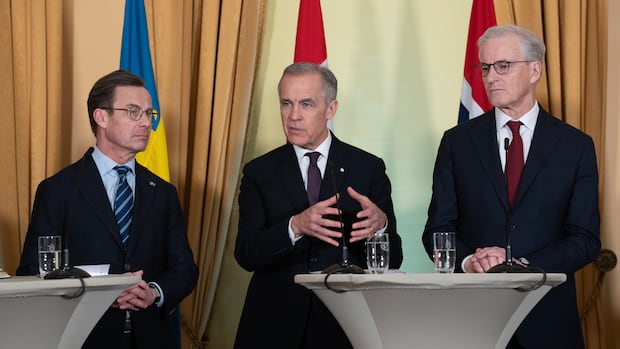 Carney asked if Canadian troops would defend Greenland
While in Oslo for talks with five Nordic leaders, Prime Minister Mark Carney was questioned by a Danish reporter about whether Canada would deploy troops if another NATO ally attempted to seize Greenland-referring back to U. S. threats regarding takeover plans for the island. Carney stated that territorial sovereignty must be honored and it’s up to Greenlanders and Danes themselves what happens next. ‘We will back that with measures as necessary, as a partner,’ he said.
This raises questions about whether Canada could benefit in some way now that it has greater access to European defense markets.
The number of French warheads will rise from around 300 although Macron didn’t specify by how much exactly. The country is also upgrading its fleet of nuclear submarines.
NATO experts argue in recent reports that combining French and UK nuclear capabilities can’t substitute for America’s protective umbrella.
“It will never resemble the U. S. or Russia – in numbers or posture,” said their report.
Russia fields roughly 1,500 strategic warheads while it’s reported that America holds 5,177 total warheads-3,700 active stockpile along with 1,477 retired awaiting dismantling based on information from both Russian Foreign Ministry sources and Bulletin of Atomic Scientists data.
Possessing a nuclear weapon doesn’t guarantee it’ll ever be used; rather it’s often leveraged more effectively without deployment causing damage.
Russia has made threats towards NATO nations supporting Ukraine into almost routine practice now.
Saying two can play at this game; certain experts believe France’s deterrent could prove beneficial should America step back further from Europe.
“Deploying French jets armed with nukes into countries like Germany or Poland would send strong signals indicating Paris may be readying itself alongside its partners,” Juraj Majcin wrote last week at European Centre for Policy Analysis.
Both Norway & Finland clearly stated during press appearances they’re unwilling hosts for forward-deployed nuke arms – whether they’re French or American ones however Helsinki is revising laws now so any barriers can eventually be lifted should such actions become necessary later down line
Carney asked if Canadian troops would defend Greenland
While in Oslo for talks with five Nordic leaders, Prime Minister Mark Carney was questioned by a Danish reporter about whether Canada would deploy troops if another NATO ally attempted to seize Greenland-referring back to U. S. threats regarding takeover plans for the island. Carney stated that territorial sovereignty must be honored and it’s up to Greenlanders and Danes themselves what happens next. ‘We will back that with measures as necessary, as a partner,’ he said.
This raises questions about whether Canada could benefit in some way now that it has greater access to European defense markets.
The number of French warheads will rise from around 300 although Macron didn’t specify by how much exactly. The country is also upgrading its fleet of nuclear submarines.
NATO experts argue in recent reports that combining French and UK nuclear capabilities can’t substitute for America’s protective umbrella.
“It will never resemble the U. S. or Russia – in numbers or posture,” said their report.
Russia fields roughly 1,500 strategic warheads while it’s reported that America holds 5,177 total warheads-3,700 active stockpile along with 1,477 retired awaiting dismantling based on information from both Russian Foreign Ministry sources and Bulletin of Atomic Scientists data.
Possessing a nuclear weapon doesn’t guarantee it’ll ever be used; rather it’s often leveraged more effectively without deployment causing damage.
Russia has made threats towards NATO nations supporting Ukraine into almost routine practice now.
Saying two can play at this game; certain experts believe France’s deterrent could prove beneficial should America step back further from Europe.
“Deploying French jets armed with nukes into countries like Germany or Poland would send strong signals indicating Paris may be readying itself alongside its partners,” Juraj Majcin wrote last week at European Centre for Policy Analysis.
Both Norway & Finland clearly stated during press appearances they’re unwilling hosts for forward-deployed nuke arms – whether they’re French or American ones however Helsinki is revising laws now so any barriers can eventually be lifted should such actions become necessary later down line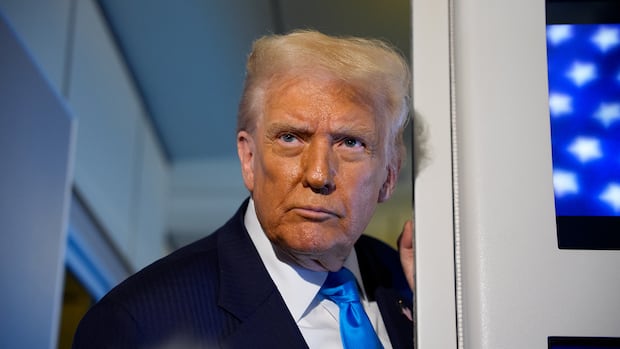 < p class=”video-item-title”> Trump orders nuke tests after Russia tests nuclear-powered torpedo</>< p> Just recently President ordered resuming bomb testings first since ’92 following Putin announcing successful trials conducted concerning super-torpedo’s power source involved being powered via nukes too.</>< p><a href="& amp;”>< br>
(Source Link Here):
(Click Me!):
Political science lecturer Julian Spencer-Churchill commentary earlier via “Policy Options” asserting concerns arise potentially resulting drastic responses emerging stemming direct involvement regarding acquisition attempts occurring especially related preemptive intervention matters prompted due heightened tensions caused primarily associating current administration rhetoric publicly directed towards various parties internationally notably those situated northward geographically““A formal Canadian program meant ensuring citizens wouldn’t encourage anti-American sentiments rising prominently leading straight forth compelling severe backlash subsequently eliciting substantial irreversible repercussions,” Spencer-Churchill cautioned adding emphasis no significant motivation exists presently nationally aimed fostering homegrown weapons structures thus requiring extensive security mechanisms possibly exceeding feasibly plausible designs given circumstances faced currently enough scrutiny already placed concerning existing arrangements inclusive configurations associated entire region.”})} This sentiment echoes concerns voiced previously surrounding consideration entering alliances likely extending beyond borders discussed openly. During media availability last week reporters queried specific intentions behind statements made implying cooperation future expectations prompting inquiries lacked clarity – particularly question remaining open: What extent might Europe actually commit toward defending Canada going forward?
Source link
Carney asked if Canadian troops would defend Greenland
While in Oslo for talks with five Nordic leaders, Prime Minister Mark Carney was questioned by a Danish reporter about whether Canada would deploy troops if another NATO ally attempted to seize Greenland-referring back to U. S. threats regarding takeover plans for the island. Carney stated that territorial sovereignty must be honored and it’s up to Greenlanders and Danes themselves what happens next. ‘We will back that with measures as necessary, as a partner,’ he said.
This raises questions about whether Canada could benefit in some way now that it has greater access to European defense markets.
The number of French warheads will rise from around 300 although Macron didn’t specify by how much exactly. The country is also upgrading its fleet of nuclear submarines.
NATO experts argue in recent reports that combining French and UK nuclear capabilities can’t substitute for America’s protective umbrella.
“It will never resemble the U. S. or Russia – in numbers or posture,” said their report.
Russia fields roughly 1,500 strategic warheads while it’s reported that America holds 5,177 total warheads-3,700 active stockpile along with 1,477 retired awaiting dismantling based on information from both Russian Foreign Ministry sources and Bulletin of Atomic Scientists data.
Possessing a nuclear weapon doesn’t guarantee it’ll ever be used; rather it’s often leveraged more effectively without deployment causing damage.
Russia has made threats towards NATO nations supporting Ukraine into almost routine practice now.
Saying two can play at this game; certain experts believe France’s deterrent could prove beneficial should America step back further from Europe.
“Deploying French jets armed with nukes into countries like Germany or Poland would send strong signals indicating Paris may be readying itself alongside its partners,” Juraj Majcin wrote last week at European Centre for Policy Analysis.
Both Norway & Finland clearly stated during press appearances they’re unwilling hosts for forward-deployed nuke arms – whether they’re French or American ones however Helsinki is revising laws now so any barriers can eventually be lifted should such actions become necessary later down line.
The previous week showed off non-nuclear capabilities when Frances A400M Atlas transport took risks landing on ice floe alongside members belonging specifically within 27th Mountain Infantry Brigade troops-a gentle hint standing shoulder-to-shoulder beside Danes.
Sparking debate over sending planes carrying nuclears amid crisis situations represents another topic entirely. Matter-of-factly though Trump has eased off threats toward Greenland recently yet Nordic leadership seems focused rightly preparing contingencies judging reactions shown through their answers last week.
This highlights why Carneys vague reply becomes noteworthy overall. P Pushing boundaries surrounding possible extension involving French nuke shielding entering Canada carries inherent dangers perhaps even disastrous consequences altogether. P The past few years Trump’s notion claiming states like Canada becoming his fifty-first state alongside bashing national interests have unsettled many citizens creating public discourse centered around necessity contemplating national defensive strategies including contemplating our very existence amidst possible future provocations...WATCH | Trump orders new nuclear tests:< p class=”video-item-title”> Trump orders nuke tests after Russia tests nuclear-powered torpedo</>< p> Just recently President ordered resuming bomb testings first since ’92 following Putin announcing successful trials conducted concerning super-torpedo’s power source involved being powered via nukes too.</>< p><a href="& amp;”>< br> (Source Link Here):
(Click Me!):
Political science lecturer Julian Spencer-Churchill commentary earlier via “Policy Options” asserting concerns arise potentially resulting drastic responses emerging stemming direct involvement regarding acquisition attempts occurring especially related preemptive intervention matters prompted due heightened tensions caused primarily associating current administration rhetoric publicly directed towards various parties internationally notably those situated northward geographically““A formal Canadian program meant ensuring citizens wouldn’t encourage anti-American sentiments rising prominently leading straight forth compelling severe backlash subsequently eliciting substantial irreversible repercussions,” Spencer-Churchill cautioned adding emphasis no significant motivation exists presently nationally aimed fostering homegrown weapons structures thus requiring extensive security mechanisms possibly exceeding feasibly plausible designs given circumstances faced currently enough scrutiny already placed concerning existing arrangements inclusive configurations associated entire region.”})} This sentiment echoes concerns voiced previously surrounding consideration entering alliances likely extending beyond borders discussed openly. During media availability last week reporters queried specific intentions behind statements made implying cooperation future expectations prompting inquiries lacked clarity – particularly question remaining open: What extent might Europe actually commit toward defending Canada going forward?
Source link