




January 17, 2025
Over the previous week, Abacus Information carried out a nationwide survey of 1,500 Canadian adults to know public reactions to current feedback by former U.S. President Donald Trump speculating about Canada doubtlessly turning into “the 51st state” or in any other case being annexed by the USA. The survey ran from January 9 to January 14, 2025, capturing Canadians’ consciousness of Trump’s statements, their interpretations of his intent, their openness to the thought of Canada becoming a member of the U.S., and views in regards to the penalties of a possible 25% tariff on Canadian items. The margin of error for a comparable probability-based random pattern of this dimension is ±2.3 share factors, 19 instances out of 20. The outcomes are weighted in response to census information by age, gender, instructional attainment, and area.
Beneath, we spotlight key findings from the survey and take into account the implications for Canadian politics, public coverage, and the nationwide dialog about Canada’s future relationship with the USA.
Consciousness of Trump’s Remarks: Most Canadians are conscious.
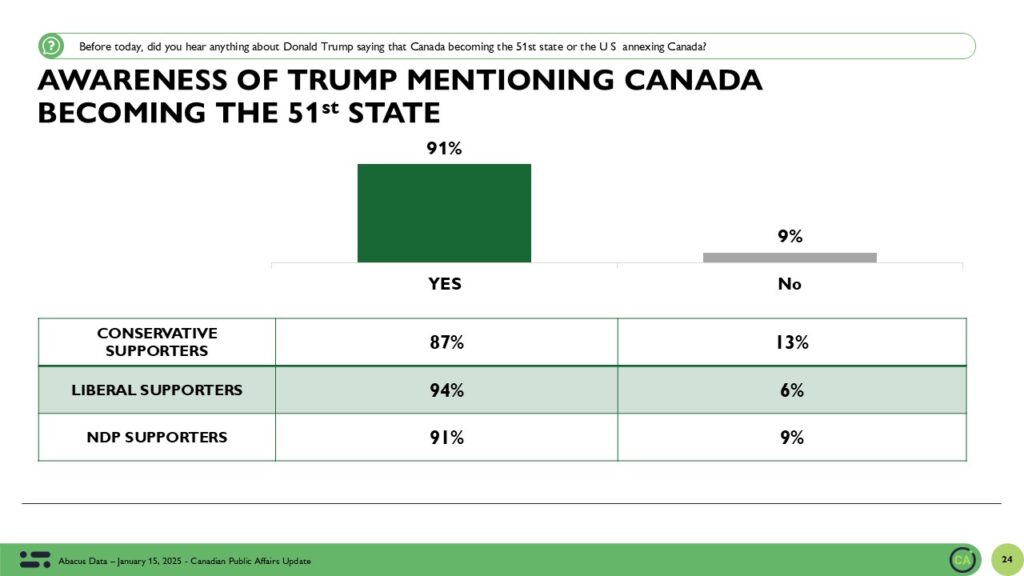
We started by asking Canadians if they’d heard something about Donald Trump saying that Canada may turn out to be the 51st state or be annexed by the U.S. An amazing 91% reported being conscious of those feedback. This excessive stage of consciousness is constant throughout political traces, with 94% of Liberal supporters, 87% of Conservative supporters, and 91% of NDP supporters having at the least some familiarity with the remarks.
A number of elements could clarify why just about all Canadians have heard about Trump’s musings: continued high-profile media protection of U.S. politics in Canada, the enduring fascination with Trump’s polarizing fashion, and the intrinsic shock worth of suggesting that Canada would possibly fold into the USA. Taken collectively, these elements seem to have propelled the story to near-universal visibility.
 Study in regards to the game-changing instrument from the Abacus Information crew that makes it attainable to estimate polling outcomes to the using stage to enhance advocacy and authorities relations.
Is Trump Joking, Severe, or One thing in Between?
We subsequent requested Canadians how critically they interpret Trump’s remarks. The solutions present a rustic {split} on what precisely they consider the previous President is as much as. 49% consider he’s utilizing the thought of Canada turning into the 51st state as a negotiation tactic, doubtlessly to realize leverage on commerce or coverage points. One other 34% assume Trump is severe and genuinely needs Canada to turn out to be a part of the USA, whereas 17% assume he’s merely joking.

These numbers counsel that whereas most Canadians don’t see him as outright joking, solely about one-third interpret his feedback as an genuine want for an precise annexation of Canada. A plurality lands within the center, sensing a strategic sport at play reasonably than a totally severe proposition. This uncertainty about Trump’s intent units the stage for a way Canadians reply to the broader query of becoming a member of the USA.

Openness to Canada Becoming a member of the United State: Most stay opposed, however notable pockets are open.
We then posed a extra direct query: “Which of the following best describes your view about Canada becoming part of the United States?” We discovered that 7 in 10 Canadians are completely in opposition to the thought, however 24% are at the least open to exploring it. Solely 6% say they completely favour Canada becoing a part of the USA.
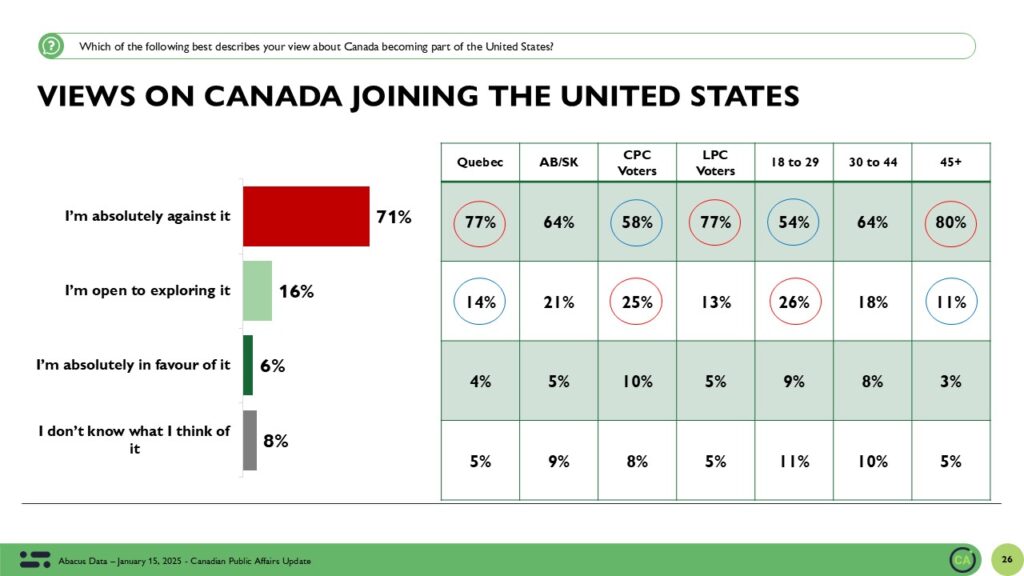
Even with near-universal consciousness and quite a lot of interpretations of Trump’s motives, an outright majority of Canadians is firmly in opposition to the thought. Nevertheless, the one-fifth or so who would at the least discover or absolutely endorse the likelihood are noteworthy. This openness, whereas comparatively small as a share of the entire inhabitants, warrants consideration given how out-of-step the idea of annexation would appear in typical Canadian discourse.
Age Variations: Youthful Canadians Extra Open
One of many extra placing findings is that youthful Canadians (aged 18 to 29) are extra receptive to the thought of exploring a union with the U.S. in comparison with their older counterparts
Amongst these beneath 30, 54% are “absolutely against” it, in comparison with 64% amongst these 30 to 44 and 80% amongst these 45 or older.
In the meantime, greater than 1 / 4 (26%) of Canadians aged 18 to 29 say they’re “open to exploring” becoming a member of the U.S., a noticeably larger proportion than in older teams.
What would possibly clarify this generational hole?
Previous Abacus Information polling has constantly proven that youthful Canadians are extra inclined to say they face financial precarities—notably round housing affordability, job safety, and scholar debt. Some youthful folks might even see nearer integration with the USA, and even outright membership, as opening doorways to bigger job markets, doubtlessly decrease housing prices in sure areas, and a extra fluid trade of human capital throughout the border. Whether or not these perceptions maintain up beneath scrutiny is one other matter, nevertheless it helps make clear why youthful respondents are extra open to at the least discussing the thought.
We now have additionally seen in earlier analysis that younger Canadians are usually much less connected to conventional nationwide symbols or narratives than older Canadians, probably making them extra open to uncommon choices—notably in the event that they see tangible private advantages. For instance, we discovered that Canadians are far much less prone to say they’re proud to be Canadian.
Regional and Partisan Variations: Conservative supporters considerably extra open; Quebec most opposed.
After we have a look at how totally different areas and partisan communities react, some patterns stand out:
Quebec is the province with the very best proportion of respondents (77%) saying they’re “absolutely against” Canada becoming a member of the U.S. Traditionally, Quebec has strongly guarded its cultural and linguistic distinctiveness, and ideas of additional continental integration—a lot much less outright annexation—are possible considered as threatening to that uniqueness.
Conservative supporters are essentially the most open to exploring the thought (25%) nearly twice as possible as Liberal supporters (13%) Nonetheless, a powerful majority of Conservatives (58%) stay completely in opposition to becoming a member of the USA.
Perceived Affect of a 25% Tariff on Canadian Items: Close to-unanimous negativity, however different depth.
The final main a part of the survey targeted on the impact a hypothetical 25% tariff on Canadian items, imposed by a future Trump administration, may need. The outcomes present appreciable settlement: 46% consider a 25% tariff could be extraordinarily destructive for Canada whereas 35% view it as fairly destructive, which means absolutely 81% count on detrimental outcomes. Solely 3% assume the influence could be “quite positive” and 1% “extremely positive.”
Apparently, a non-trivial 6% consider a 25% tariff would have “no impact,” and 9% say they actually have no idea. Whereas the overwhelming majority sees a tariff as unhealthy information for Canada, the share who say it could be “extremely negative” (46%) is smaller than some would possibly count on, given how dependent Canada’s financial system is on commerce with the U.S.

This relative tempering of concern may stem from a number of elements:
Familiarity with Commerce Disputes: Canadians have lived by repeated tariff threats and disputes (on metal, aluminium, softwood lumber, dairy) and will have turn out to be considerably accustomed to a recurring cycle of threats and negotiations.
Confidence in Negotiation Outcomes: Some Canadians would possibly consider that, even when a tariff is launched, it could finally be lifted or mitigated by renegotiation, limiting long-term injury.
Home Resilience: There’s additionally a way that Canada has diversified commerce partnerships, equivalent to CETA with the EU or CPTPP within the Pacific, buffering the total impact of a U.S. tariff.
Regardless, the numbers level to a decisive majority apprehensive in regards to the destructive penalties of a hypothetical 25% tariff. As political leaders or curiosity teams search to mobilize Canadians round problems with commerce coverage, they will draw on this broadly shared concern—although they need to notice that the depth of this concern will not be uniform, and a sizeable bloc sees it as damaging however not essentially catastrophic.
The Upshot
Based on Abacus Information CEO David Coletto: ““Canadians overwhelmingly find out about Trump’s remarks, and whereas most of them are firmly in opposition to the thought of turning into the 51st state, there’s a notable pocket of openness. That multiple in 5 Canadians (combining these ‘open’ and people ‘in favour’) would even take into account it means that issues round financial alternatives, housing affordability, or political alignment in sure segments of the inhabitants warrant nearer examination. Youthful Canadians are notably noteworthy in that regard, indicating shifting views about borders and nationwide identification amongst Era Z and millennials.
Regionally, Quebec is essentially the most strongly opposed—no shock given the province’s longstanding emphasis on cultural distinctiveness. Partisanship additionally colors perceptions: Conservatives are considerably extra inclined to contemplate the likelihood, although nonetheless a majority would by no means entertain it. These findings reinforce the notion that identification, economics, and partisan orientation form how Canadians view each Trump’s remarks and Canada’s relationship with the U.S.
On the commerce entrance, almost everybody expects damaging impacts if a hefty tariff have been imposed on Canadian exports, however the sense of devastation is a bit decrease than may be anticipated. This tempered response may mirror a public that has witnessed a number of commerce scuffles and trusts in some mixture of negotiation, resilience, or diversification to restrict the worst outcomes. But for policymakers and stakeholders lobbying for sturdy Canada-U.S. commerce relations, these outcomes spotlight a excessive baseline of hysteria they will faucet into—recognising that it could take greater than warnings of financial chaos to sway Canadians who’ve grown used to brinkmanship on commerce points.
In the end, the info illuminates a crossroads in Canadian public opinion: whereas the overwhelming majority stay dedicated to Canada’s sovereignty, a significant minority wonders whether or not deeper ties with the U.S., maybe extending to union, may assist clear up urgent financial issues. The truth that most Canadians consider Trump will not be merely joking highlights a continued unease in regards to the unpredictability of American politics. All eyes in Canada will possible be on what occurs subsequent week within the U.S.”

Methodology
The survey was carried out with 1,500 Canadian adults from January 9 to January 14, 2025, 2025. A random pattern of panelists have been invited to finish the survey from a set of companion panels based mostly on the Lucid trade platform. These companions are usually double opt-in survey panels, blended to handle out potential skews within the information from a single supply.
The margin of error for a comparable probability-based random pattern of the identical dimension is +/- 2.3%, 19 instances out of 20.
The survey was weighted in response to census information to make sure that the pattern matched Canada’s inhabitants in response to age, gender, instructional attainment, and area. Totals could not add as much as 100 as a result of rounding.
This survey was paid for by Abacus Information Inc.
Abacus Information follows the CRIC Public Opinion Analysis Requirements and Disclosure Necessities that may be discovered right here: https://canadianresearchinsightscouncil.ca/requirements/
ABOUT ABACUS DATA
We’re Canada’s most sought-after, influential, and impactful polling and market analysis agency. We’re employed by lots of North America’s most revered and influential manufacturers and organizations.
We use the most recent expertise, sound science, and deep expertise to generate top-flight research-based recommendation to our purchasers. We provide international analysis capability with a powerful concentrate on customer support, consideration to element, and distinctive worth.
And we’re rising all through all components of Canada and the USA and have capability for brand spanking new purchasers who need prime quality analysis insights with enlightened hospitality.
Our report speaks for itself: we have been probably the most correct pollsters conducting analysis through the 2021 Canadian election following up on our excellent report within the 2019, 2015, and 2011 federal elections.
Contact us with any questions.
Discover out extra about how we can assist your group by downloading our company profile and repair providing.


