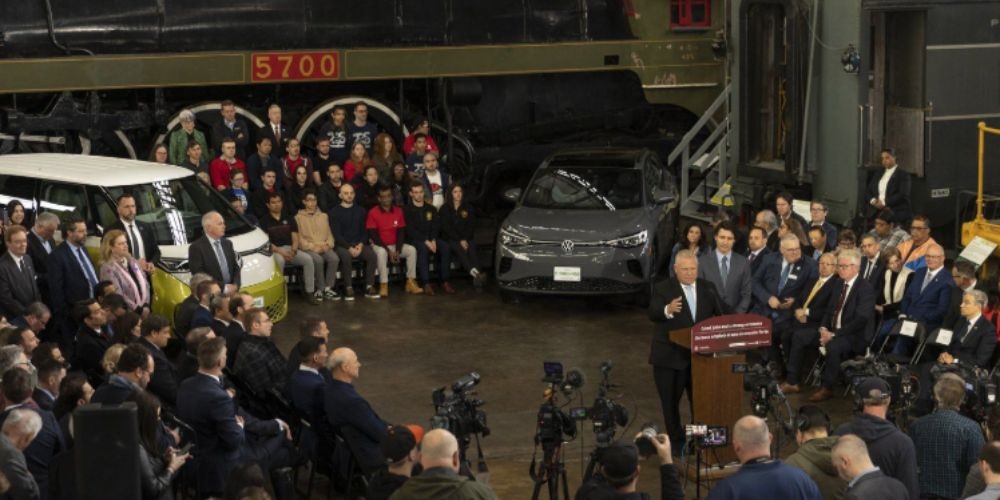
Ontario’s ambition for a complete electric vehicle supply chain, which was once a major focus for Premier Doug Ford, has been struggling as manufacturers postpone or scrap plans. The government is now shifting its attention to different battery needs to keep the initiative alive.
Ford and the federal government worked together to attract three electric vehicle battery plants to Ontario-projects totaling billions of dollars. They hoped not only to have these batteries used in locally produced EVs but also made with parts sourced from Ontario and minerals mined and processed within the province.
However, just a few years after launching this vision, its initial promise is fading.
Barrie’s News Delivered To Your Inbox
Stay updated on what’s happening in Barrie. Get the latest local news sent directly to your inbox every day. Don’t miss out on important updates..
Consent Info
By submitting this form, you agree to receive marketing emails from: Central Ontario Broadcasting, 431 Huronia Rd, Barrie, Ontario, CA, https://www. cobroadcasting. com. You can unsubscribe at any time using the Safe Unsubscribe® link found at the bottom of every email. Emails are managed by Constant Contact
Honda was set to establish an EV battery plant and manufacture electric vehicles in Alliston but postponed its project due to falling demand. Umicore has halted its plans for a cathode plant in eastern Ontario. General Motors stopped production of its Bright Drop electric delivery van in Ingersoll. Ford has delayed plans for producing electric vehicles in Oakville while shifting focus back to F-Series gas-powered pickup trucks.
The premier believes that a new agreement between Canada and China poses further threats to Ontario’s auto industry by nearly eliminating tariffs on Chinese EVs in exchange for China reducing tariffs on canola oil. However, some experts argue that making cheaper Chinese EVs available could actually help boost overall demand for green vehicles and support domestic manufacturing over time.
While global demand for electric vehicles continues to rise, uncertainty regarding rebates is holding back interest in Canada; concerns over federal sales mandates and trade relations with the U. S. are undermining investor confidence according to experts.
Stellantis is tackling this downturn differently.
The Next Star Energy facility in Windsor, Ont., which is a partnership with LG and already had some construction underway when market trends shifted, will now be focusing on producing energy storage batteries instead of just EV batteries.
“As an EV battery manufacturer, we faced a huge setback due to the market conditions,” said Next Star CEO Danies Lee during an interview. “But as a battery manufacturer that deals with all different applications it’s a great opportunity.” Right now there’s significant demand for storage batteries and other uses like AI-driven machines.
Economic Development Minister Vic Fedeli remarked that Stellantis’ change aligns well with their broader plan for an end-to-end EV supply chain-even if it looks slightly different at this stage.
“(Stellantis’ pivot) is with our full understanding, our blessing, and in fact, our encouragement,” he stated during an interview last month.
The necessary minerals for those storage batteries will still need mining and ideally refining done in Ontario along with parts like separators being produced there too. Asahi Kasei’s separator facility planned for the Niagara Region is proceeding despite initially being linked with Honda’s EV projects.
Fedeli indicated that there’s no interest from the government in interventions aimed at stimulating the market specifically for electric vehicles or their batteries; they simply want companies building here-the actual products don’t matter as much.
“These are multi-billion dollar multinational companies who’ve made choices about what they want to build,” he explained. “If they decide they want something built here then we’ll assist them. We just want jobs.” He added that when Ford (Motor Co.) expressed interest in switching from their EV line back to F-150 trucks; his response took just five seconds.
This marks quite a shift compared to about 18 months ago when Fedeli was optimistic about Ontario’s prospects within the EV supply chain.
“Electric vehicle sales are increasing year after year without fail,” he claimed confidently back in July 2024 while emphasizing their belief that they’d positioned Ontario as a top choice globally for electric vehicle manufacturing.
Joanna Kyriazis from Simon Fraser University’s clean energy think tank believes North America will see renewed demand align more closely with worldwide trends eventually.
“Globally, EV sales continue breaking records throughout 2025,” she stated.
“Sales rose by 20 percent around the globe-with countries like China reporting over 50 percent new car sales being electric.” In Europe it hovered around 30 percent.. Several developing nations such as Brazil and Thailand experienced massive spikes too-largely thanks access low-cost Chinese models.” Sam Fiorani at Auto Forecast Solutions noted it’s likely there’ll eventually be capacity needed again down the road but achieving it won’t happen within five years.
“Investments poured into battery production haven’t seen ramped-up demand matched,” he said,
“so they’ll require another outlet soon enough.” Batteries designed specifically for stationary storage represent one good option short-term-wise.” 🎧 Local news stories matter most so subscribe via Spotify or Apple Podcasts wherever you enjoy listening-to stay informed daily!
Source link
“Globally, EV sales continue breaking records throughout 2025,” she stated.
“Sales rose by 20 percent around the globe-with countries like China reporting over 50 percent new car sales being electric.” In Europe it hovered around 30 percent.. Several developing nations such as Brazil and Thailand experienced massive spikes too-largely thanks access low-cost Chinese models.” Sam Fiorani at Auto Forecast Solutions noted it’s likely there’ll eventually be capacity needed again down the road but achieving it won’t happen within five years.
“Investments poured into battery production haven’t seen ramped-up demand matched,” he said,
“so they’ll require another outlet soon enough.” Batteries designed specifically for stationary storage represent one good option short-term-wise.” 🎧 Local news stories matter most so subscribe via Spotify or Apple Podcasts wherever you enjoy listening-to stay informed daily!
Source link