



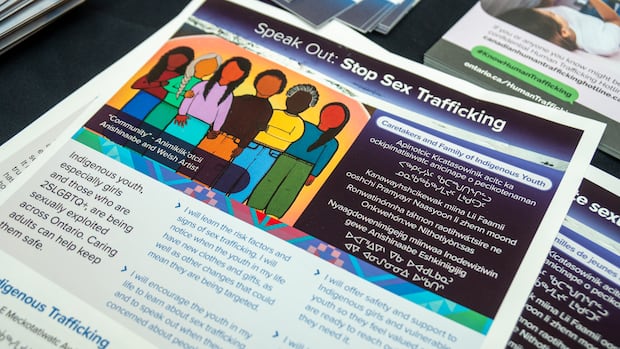
Raising awareness about what human trafficking is and recognizing signs that might help someone avoid exploitation is crucial in Thunder Bay, Ont. – a city identified as a major hotspot for trafficking in Canada based on federal data.
“It’s happening here in Thunder Bay. A lot of people don’t think it is, but it is,” Cindy Paypompee, co-chair of the Thunder Bay Coalition to End Human Trafficking, said Friday.
Paypompee was interviewed by ahead of National Human Trafficking Awareness Day on Sunday. The coalition – formed in 2018 and made up of law enforcement, health, education, and social service providers – held an awareness event at the Intercity Shopping Centre on Friday.
According to Statistics Canada, more than 5,000 human trafficking incidents were reported to police between 2014 and 2024. Thunder Bay had the highest average annual rates in Canada during that decade among cities with around 118,000 residents.
The average annual rate for Thunder Bay stood at 8.0 per 100,000 population, compared to the national average of 1.5 per 100,000 population according to a report released by the data agency in December.
The report highlights that vulnerable groups-like migrants, youth in care, Indigenous women and girls, and those living in poverty-are particularly at risk.
Ontario and Nova Scotia are the only provinces showing rates above the national average; both recorded high rates again in 2024 as stated by the report.
![]() The Thunder Bay District Health Unit distributed condoms during Friday’s human trafficking awareness event to help promote sexual health. (Sarah Law/CBC)
Paypompee aims to create a pamphlet or resource guide that could be widely shared to protect individuals from exploitation.
For now, they’re sharing information through their website.
<p“Signs of a person who may be trafficked; safety planning; local resources in Thunder Bay,” she said,“just to bring awareness to people … of what trafficking is and assist someone who may need help.”
The Thunder Bay District Health Unit distributed condoms during Friday’s human trafficking awareness event to help promote sexual health. (Sarah Law/CBC)
Paypompee aims to create a pamphlet or resource guide that could be widely shared to protect individuals from exploitation.
For now, they’re sharing information through their website.
<p“Signs of a person who may be trafficked; safety planning; local resources in Thunder Bay,” she said,“just to bring awareness to people … of what trafficking is and assist someone who may need help.”
![]() Students from Lakehead University’s accelerated social work program have teamed up with the Thunder Bay Coalition to End Human Trafficking for sharing research efforts. Top left to right: Steven Kearney, Kris Carlson. Bottom left to right: Shanta Paudel, Tessa Pasqualino. (Sarah Law/CBC)
This semester requires students like Kearney and his classmates to develop a mock advocacy campaign which they decided to present at Friday’s event.
Students from Lakehead University’s accelerated social work program have teamed up with the Thunder Bay Coalition to End Human Trafficking for sharing research efforts. Top left to right: Steven Kearney, Kris Carlson. Bottom left to right: Shanta Paudel, Tessa Pasqualino. (Sarah Law/CBC)
This semester requires students like Kearney and his classmates to develop a mock advocacy campaign which they decided to present at Friday’s event.
Connecting with shoppers at Thunder Bay’s mall enables organizations like theirs reach out across different community segments who might not know much beyond media portrayals about this issue said Kearney.
“In big media stories like movies or news reports it seems like international crime involving huge rings moving people around but it’s much more complex than that,” he explained.
“For me raising awareness means demystifying things rather than relying solely on those media narratives. This isn’t Taken with Liam Neeson,” referring jokingly about the film focused on rescuing a kidnapped girl related back into larger themes of crime against women.“ It’s actually more subtle than you think.” When Paypompee began her advocacy journey she sought guidance from an elder who offered her wisdom leading them toward naming Beendigen’s annual anti-human trafficking conference held alongside Nokiiwin Tribal Council. “The name we came up with was Wi Na Wenjikaazo which translates into Ojibway meaning ‘They are taken care of,’” she stated. “We want everyone.. who finds themselves being trafficked [to know] there are people willing support them.”
Source link
‘We’re just doing this on our own’
For Paypompee and others involved with the coalition, their efforts to prevent human trafficking are ongoing work that matters deeply. <p“ This is not a funded coalition. We're just doing this on our own,” said Paypompee, who works at Beendigen (also known as the Anishinabe Women's Crisis Home and Family Healing Agency).The issue largely remains ‘behind closed doors’
Steven Kearney studies social work through Lakehead University’s accelerated program where students explore various issues affecting northwestern Ontario. Kearney is among several students focusing their research on human trafficking as part of their studies. <p“There's so many crossovers between a number of other issues-gender-based violence; domestic violence; murdered and missing Indigenous women and girls-and human trafficking is something we often fail to recognize properly because it's so behind closed doors,” he noted.Connecting with shoppers at Thunder Bay’s mall enables organizations like theirs reach out across different community segments who might not know much beyond media portrayals about this issue said Kearney.
“In big media stories like movies or news reports it seems like international crime involving huge rings moving people around but it’s much more complex than that,” he explained.
“For me raising awareness means demystifying things rather than relying solely on those media narratives. This isn’t Taken with Liam Neeson,” referring jokingly about the film focused on rescuing a kidnapped girl related back into larger themes of crime against women.“ It’s actually more subtle than you think.” When Paypompee began her advocacy journey she sought guidance from an elder who offered her wisdom leading them toward naming Beendigen’s annual anti-human trafficking conference held alongside Nokiiwin Tribal Council. “The name we came up with was Wi Na Wenjikaazo which translates into Ojibway meaning ‘They are taken care of,’” she stated. “We want everyone.. who finds themselves being trafficked [to know] there are people willing support them.”
Source link