



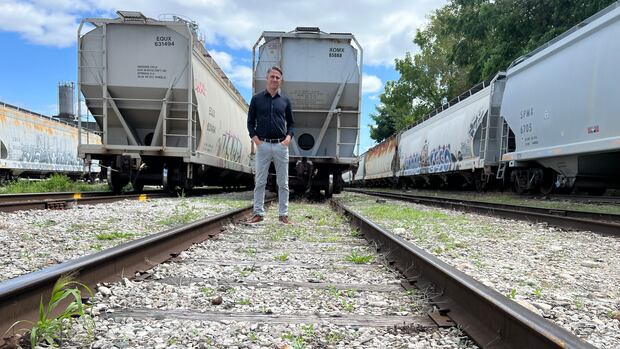
For business executive Daniel Peretz, the threat of a railway strike or lockout is more than just news.
“The rail service is our lifeline,” he said. “Without the rail service, we don’t operate the business, we don’t have 13 employees working here, we’re unable to service a very important industry.”
Peretz is president and CEO of Nex Gen Polymers, a facility that handles transloading plastics and operates from a warehouse and office located just east of downtown London, Ont.
Outside the building’s brick walls, there’s a collection of railway sidings that can hold around 40 railcars. Each graffiti-covered railcar carries plastic pellets sent to the site by petroleum companies from across North America and beyond.
Twice each week, a Canadian Pacific Kansas City (CPKC) crew comes to pick up about 10 empty cars from Nex Gen and swap them out with loaded ones.
The plastic pellets-each roughly the size of an unpopped popcorn kernel-arrive at Peretz’s site in different colors and grades.
The pellets are vacuumed out of the railcars into storage tanks for testing, mixing, and eventual delivery by truck to customers. The manufacturers Peretz supplies turn those pellets into products and packaging that Canadians see on nearly every store shelf.
“Plastic water bottles, the overwrap for toilet paper-really every aspect of every component of what we purchase today is made from plastic, from industrial products to food to medical,” he said.
![]() Peretz hasn’t much in the way of details from Canadian Pacific Kansas City, the rail company he relies on for twice-weekly deliveries of plastic pellets. (Andrew Lupton/CBC)
He mentioned any lengthy disruption in railway service would create significant challenges throughout the supply chain.
“Our customers would feel it based on the price per pound that they pay for material,” he stated.
Perez points out there’s no alternative way to get plastic pellets delivered quickly enough to meet his warehouse needs; trucks simply can’t fill this gap as he explained.
“A rail car is 200,000 pounds net weight of material.. I’d have to do four trucks to get that same volume,” he noted. “You’re adding tremendous cost, tremendous CO2 emissions.”
Peretz hasn’t much in the way of details from Canadian Pacific Kansas City, the rail company he relies on for twice-weekly deliveries of plastic pellets. (Andrew Lupton/CBC)
He mentioned any lengthy disruption in railway service would create significant challenges throughout the supply chain.
“Our customers would feel it based on the price per pound that they pay for material,” he stated.
Perez points out there’s no alternative way to get plastic pellets delivered quickly enough to meet his warehouse needs; trucks simply can’t fill this gap as he explained.
“A rail car is 200,000 pounds net weight of material.. I’d have to do four trucks to get that same volume,” he noted. “You’re adding tremendous cost, tremendous CO2 emissions.” The company typically receives around 20 railcars weekly filled with plastic pellets used for producing packaging among other goods. (Andrew Lupton/CBC)
Perez isn’t alone in wanting prompt resolutions between railway operators and unions so trains keep running smoothly.
Crosby Devitt runs a grain farm as well as serves as CEO of Grain Farmers Ontario located Kincardine.
The company typically receives around 20 railcars weekly filled with plastic pellets used for producing packaging among other goods. (Andrew Lupton/CBC)
Perez isn’t alone in wanting prompt resolutions between railway operators and unions so trains keep running smoothly.
Crosby Devitt runs a grain farm as well as serves as CEO of Grain Farmers Ontario located Kincardine.
He pointed out approximately $43 million worth grains gets shipped daily by rail within Canada. “Even within our industry we sometimes underestimate how vital trains are,” he remarked. “Whenever disruptions loom it really highlights their importance.”
If shipping stops happening they may run low on storage fast. Last Thursday federal Labour Minister Steven Mac Kinnon turned down CN’s request seeking binding arbitration stating he’d like them bargaining fairly instead.
Devitt stressed it’s critical government intervenes without delay should negotiations falter between railway firms along unions involved. “We know parties involved want solutions but we urge federal officials not let this escalate further because nobody benefits when disruptions impact economies like this.” If you want updates regarding looming threats posed towards freight systems across province tune into Afternoon Drive featuring host Matt Allen who talks Crosby Devitt concerning concerns shared among farmers statewide.
Source link
Dispute Triggers Chain Reaction
A labor dispute involving both Canadian National and CPKC threatens not only Peretz’s operation but also many manufacturers relying on his supply chain. The Canadian Federation of Independent Business has warned that a lockout could be devastating for small businesses depending on rail services. Railways transport over $1 billion worth of goods daily according to the Railway Association of Canada, with more than half of Canada’s exports moving by train. Contract negotiations between the Teamsters union and these companies usually occur annually; however in 2022 CN asked for an extension on its existing deal instead of negotiating anew after new federal regulations were introduced. This resulted in both companies’ labor agreements expiring at the end of 2023 with discussions continuing since then. The companies and union have accused one another of unfair bargaining practices. The Teamsters claim CN Rail and CPKC are pushing for concessions that might jeopardize worker safety; however both operators deny these claims. On Monday, the union representing thousands at CPKC issued a 72-hour strike notice while CN Rail announced plans to lock out workers simultaneously unless an agreement or binding arbitration occurs. Daniel Peretz, president if Nex Gen Polymers, says weekly deliveries of railcars loaded with plastic pellets are the ‘lifeline’ of his business, one that would be cut off if rail service shuts down. (Andrew Lupton/CBC) As this dispute drags on, both companies have begun scaling back shipments in anticipation of potential strikes or lockouts. It’s a tense situation that could disrupt key links in an essential cross-country supply chain affecting numerous industries and businesses. Peretz has reached out to CPKC asking when his deliveries might be impacted but hasn’t received clear responses yet. The company typically receives around 20 railcars weekly filled with plastic pellets used for producing packaging among other goods. (Andrew Lupton/CBC)
Perez isn’t alone in wanting prompt resolutions between railway operators and unions so trains keep running smoothly.
Crosby Devitt runs a grain farm as well as serves as CEO of Grain Farmers Ontario located Kincardine.
The company typically receives around 20 railcars weekly filled with plastic pellets used for producing packaging among other goods. (Andrew Lupton/CBC)
Perez isn’t alone in wanting prompt resolutions between railway operators and unions so trains keep running smoothly.
Crosby Devitt runs a grain farm as well as serves as CEO of Grain Farmers Ontario located Kincardine.He pointed out approximately $43 million worth grains gets shipped daily by rail within Canada. “Even within our industry we sometimes underestimate how vital trains are,” he remarked. “Whenever disruptions loom it really highlights their importance.”
Call To Avoid Escalation
This timing surrounding possible shutdowns poses problems given crops must be harvested promptly.If shipping stops happening they may run low on storage fast. Last Thursday federal Labour Minister Steven Mac Kinnon turned down CN’s request seeking binding arbitration stating he’d like them bargaining fairly instead.
Devitt stressed it’s critical government intervenes without delay should negotiations falter between railway firms along unions involved. “We know parties involved want solutions but we urge federal officials not let this escalate further because nobody benefits when disruptions impact economies like this.” If you want updates regarding looming threats posed towards freight systems across province tune into Afternoon Drive featuring host Matt Allen who talks Crosby Devitt concerning concerns shared among farmers statewide.
Source link


