



News Farm News
Animal welfare includes the wellbeing of caretakers as well
Feb 04, 2026 •
..
Derek Haley: “We build on and feed off each other”
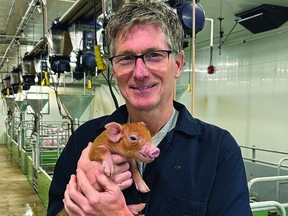
Growing up involved in 4-H with cows and horses being a big part of his life, the newly appointed director of The Campbell Centre for the Study of Animal Welfare (CCSAW) shares his long-standing love for observing animals.
This has not loaded yet, but your article continues below.
Dr. Derek Haley spoke to Ontario Farmer about his interest in animal behavior and how he realized it could be his career path.
“To understand an animal’s behaviour is pretty fascinating right there,” he stated, but over time this evolved into wanting animals to have good quality lives while acknowledging that using agricultural animals for profit can also be a compatible goal.
After earning his Masters at University of Guelph, he worked as a researcher before completing his Ph. D. at the University of Saskatchewan. He then took on a faculty position where he was the only one specializing in farm animal behavior at that institution.
“I was the only one there,” he mentioned. When an opening became available at the Campbell Centre at University of Guelph, he was thrilled to join a team of scientists where he would be both appreciated and challenged.
This has not loaded yet, but your article continues below.
“We build on and feed off each other,” he commented regarding his new role compared to working alone in the past.
At Guelph, through the work done by the Centre, people are starting to realize that positive animal welfare isn’t just a nice idea; it’s essential for sustainability.
Haley emphasized several times during our conversation that making a profit shouldn’t be viewed negatively.
The director recently wrapped up a major study project on long-distance transport of beef and is now turning his attention toward dairy cattle.
With many new constructions and modernizations underway due in part to updated Codes of Practices related to exercise requirements, farmers could greatly benefit from knowledge transfer, he explained. For instance, tie stalls are being updated and how housing impacts animals round-the-clock is significant. To navigate these facility changes and Codes effectively, farmers face many choices. A cross-industry group study could provide insights focusing on animal health and wellbeing before and after they transition into new environments. Funding is available for knowledge transfer efforts; however, securing funding for comparative studies remains necessary, he noted.
This has not loaded yet, but your article continues below.
Since COVID-19 began affecting operations, the Campbell Centre has organized both virtual and in-person seminars covering various aspects of animal welfare ranging from lab animals to farm settings as well as pets-and this will continue. He pointed out that today’s focus isn’t solely on animals anymore; it also includes their caretakers now too.
“That’s a field where our focus is evolving to people.”
Haley also serves as a faculty member within Ontario Veterinary College’s Department of Population Medicine. Its Dean Dr. Jeffrey remarked: “Dr. Haley has long been a thoughtful and respected voice in the field of animal welfare. His appointment as director of CCSAW reflects not only his deep expertise in animal behaviour and livestock systems but also his commitment to collaborative evidence-based approaches that improve the lives of animals.”
Additionally serving as Alberta’s provincial livestock welfare specialist who speaks French fluently enables him collaboration with numerous stakeholders focused on enhancing animal welfare initiatives there.
Dr. Haley succeeds Dr. Georgia Mason who remains an integral faculty member at CCSAW; she holds a professorship within University Of Guelph’s College Of Biological Sciences’ Department Of Integrative Biology.
Share this article in your social network
Source link
Source link


