



Growing up as an adoptee, Sarah Loretta Schuster didn’t have the chance to connect with her Indigenous culture. The Anishinaabe community organizer, who has family ties to Lac des Mille Lacs First Nation, often traveled beyond her home in Richmond Hill to find Indigenous medicines and participate in powwows.
That’s why she feels grateful for the new Indigenous medicine gardens created in her hometown.
“It’s also about cultural visibility,” she says. “A lot of people don’t really know that there’s Indigenous people still here. I know that when I was growing up, I didn’t always feel like it was appropriate or safe to self-identify as Indigenous.”
![]() Prairie sage is planted inside the children’s garden at Richmond Green. Sage is used for ceremonies in Indigenous culture, but it also acts as a pollinator for the ecosystem. (Kirthana Sasitharan/CBC)
The city of Richmond Hill, along with Schuster’s Miskwaadesi Studio-a community initiative focused on cultural workshops-has established five medicine gardens to provide better access to prairie sage and sweetgrass. These plants also help support pollinators.
In many Indigenous cultures, sage is used during ceremonies for smudging to cleanse spaces. Sweetgrass serves ceremonial purposes and craft work, and it can even be enjoyed as tea.
“I’ve been growing these medicines in my backyard for 10 years and giving them away,” Schuster says. “Once we started having workshops … the demand for the medicine really outgrew what I could produce. So the city really got on board with providing these wonderful spaces for us to grow medicines.”
Prairie sage is planted inside the children’s garden at Richmond Green. Sage is used for ceremonies in Indigenous culture, but it also acts as a pollinator for the ecosystem. (Kirthana Sasitharan/CBC)
The city of Richmond Hill, along with Schuster’s Miskwaadesi Studio-a community initiative focused on cultural workshops-has established five medicine gardens to provide better access to prairie sage and sweetgrass. These plants also help support pollinators.
In many Indigenous cultures, sage is used during ceremonies for smudging to cleanse spaces. Sweetgrass serves ceremonial purposes and craft work, and it can even be enjoyed as tea.
“I’ve been growing these medicines in my backyard for 10 years and giving them away,” Schuster says. “Once we started having workshops … the demand for the medicine really outgrew what I could produce. So the city really got on board with providing these wonderful spaces for us to grow medicines.”
![]() Sweetgrass is planted in a planter at Phyllis Rawlinson Park. This can be made into a braid and used for ceremonial purposes. It can also be used as a healing tea. (Kirthana Sasitharan/CBC)
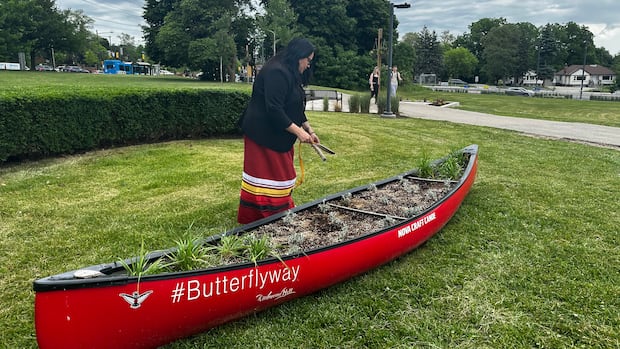
The gardens are located outside the central library inside a red canoe, at Richmond Green children’s garden, outside Oak Ridges Community Centre in another canoe, and at Phyllis Rawlinson Park. According to Schuster, these spots will also serve as cultural gathering places for prayer and ceremony.
These medicinal plants aren’t meant to replace traditional medicine.
“For a lot of Indigenous people, medicine isn’t necessarily a pill or medicine that you would see at a hospital or medical clinic,” Schuster explains. “Medicine can be anything that really completes your wholeness. Medicine in the form of smudging is a spiritual cleansing process.”
Schuster believes these gardens symbolize hope and respect for Indigenous culture while offering chances for education.
Sweetgrass is planted in a planter at Phyllis Rawlinson Park. This can be made into a braid and used for ceremonial purposes. It can also be used as a healing tea. (Kirthana Sasitharan/CBC)
The gardens are located outside the central library inside a red canoe, at Richmond Green children’s garden, outside Oak Ridges Community Centre in another canoe, and at Phyllis Rawlinson Park. According to Schuster, these spots will also serve as cultural gathering places for prayer and ceremony.
These medicinal plants aren’t meant to replace traditional medicine.
“For a lot of Indigenous people, medicine isn’t necessarily a pill or medicine that you would see at a hospital or medical clinic,” Schuster explains. “Medicine can be anything that really completes your wholeness. Medicine in the form of smudging is a spiritual cleansing process.”
Schuster believes these gardens symbolize hope and respect for Indigenous culture while offering chances for education.
![]() This Indigenous medicine garden is located outside of the Richmond Hill Library’s central branch. It’s among 5 others planted all over the city. (Kirthana Sasitharan/CBC)
This Indigenous medicine garden is located outside of the Richmond Hill Library’s central branch. It’s among 5 others planted all over the city. (Kirthana Sasitharan/CBC)
Source link
Gardens like these assist reconciliation efforts, mayor notes
Richmond Hill Mayor David West states that creating space for these Indigenous medicines focuses on reconciliation and public education. “Our Indigenous roots … are incredibly important for people to understand,” says West. “Once they understand it, then we can start moving forward with a number of big things that we need to do and heavy lifting we need to tackle.” He mentions that placing the medicines in canoes-like those outside the central library-is intended to inspire residents to ask questions and learn more. “There are 94 recommendations from the Truth and Reconciliation Commission; many involve significant actions needed at national levels while some apply on provincial levels.” He adds: “But cities matter too; that’s where everything happens.” The city will care for these plants while Schuster along with other community members plan on harvesting them later this year during public events where attendees will get hands-on experiences making sweetgrass braids or prairie sage bundles.Source link