Some butchers in the London area report that there’s no change in turkey availability for the holidays, even with an ongoing avian influenza outbreak in Ontario that has led to the culling of tens of thousands of birds.
The Canadian Food Inspection Agency (CFIA) found highly pathogenic avian influenza, or HPAI, at a farm in North Perth on Monday, impacting about 56,000 turkeys.
Last month, five more outbreaks were reported in Strathroy-Caradoc, affecting nearly 100,000 turkeys as per CFIA data. All six outbreaks are still active.
The birds will be “humanely depopulated,” said the CFIA in a statement Wednesday regarding the latest outbreak. The agency hasn’t disclosed the names or exact locations of any affected farms.
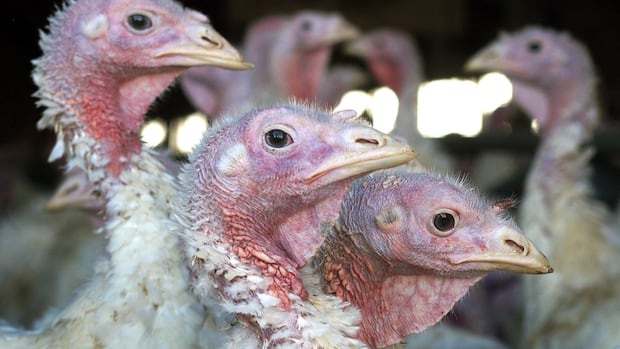
![]() Young turkeys at a farm in British Columbia are shown in this 2021 file photo. Sean Maguire, the CEO of Hayter’s Farm in Dashwood, Ont., said the culling of breeding turkeys could impact egg production in the new year. (Ben Nelms/CBC)
Hayter’s Farm in Dashwood is one of Ontario’s largest turkey suppliers and stated they aren’t directly affected; however, one breeding supplier located in Strathroy is impacted which may cause issues down the line.
“Over the next two or three months, we may feel a ripple effect,” said Hayter’s CEO Sean Maguire.
Maguire explained that there are various types of poultry farms-some focus on breeding and egg production while others like Hayter’s raise turkeys for consumption.
Maguire noted that any turkeys served during Christmas would have already been at Hayter’s barn before the avian flu outbreak occurred, so they’re healthy.
However, he mentioned that recent turkey culls will slow down industry supply until enough breeding birds start producing eggs again.
“The meat supply isn’t necessarily affected; it’s really about replacement birds. We expect to get more turkeys in about 12 to 16 weeks from now. We might see some disruption due to that loss of stock,” he added.
Young turkeys at a farm in British Columbia are shown in this 2021 file photo. Sean Maguire, the CEO of Hayter’s Farm in Dashwood, Ont., said the culling of breeding turkeys could impact egg production in the new year. (Ben Nelms/CBC)
Hayter’s Farm in Dashwood is one of Ontario’s largest turkey suppliers and stated they aren’t directly affected; however, one breeding supplier located in Strathroy is impacted which may cause issues down the line.
“Over the next two or three months, we may feel a ripple effect,” said Hayter’s CEO Sean Maguire.
Maguire explained that there are various types of poultry farms-some focus on breeding and egg production while others like Hayter’s raise turkeys for consumption.
Maguire noted that any turkeys served during Christmas would have already been at Hayter’s barn before the avian flu outbreak occurred, so they’re healthy.
However, he mentioned that recent turkey culls will slow down industry supply until enough breeding birds start producing eggs again.
“The meat supply isn’t necessarily affected; it’s really about replacement birds. We expect to get more turkeys in about 12 to 16 weeks from now. We might see some disruption due to that loss of stock,” he added.
Source link
Time to Feast
The CFIA states there’s no evidence indicating that avian influenza can be contracted from fully cooked poultry or eggs. The predominant strain circulating right now is H5N1 which spreads quickly among domestic poultry flocks. This strain affects several food-producing bird species as well as pet birds and wild birds according to CFIA reports. In rare cases, it can lead to illness in humans when people are close to infected birds or heavily contaminated areas as noted by CFIA. The owner of Pete Charlton’s Quality Meats located in St. Thomas mentioned he’s had a few inquiries about avian flu but stated customers continue ordering turkeys for their holiday feasts. He anticipates receiving around 200 turkeys on Friday. “It’s a small town. We’re really well-known from being around so long and everybody just orders it again every year,” Peter Charlton shared while expecting customers will pick them up before Christmas arrives. Other butchers across Ontario share similar sentiments stating it’s business as usual including Western Meats based in London. “We’ve just had our deliveries from our supplier and everything seems to be OK,” commented owner Jim Chioros.Source link