




Mayor Andrea Horwath describes the Ontario Land Tribunal’s (OLT) decision requiring Hamilton to expand its urban boundary by 1,600 hectares as “quite distressing.”
The ruling was announced during a hearing on Monday, following an appeal from developers against a 2025 Hamilton council decision that rejected their request to extend the boundary for development in Upper Stoney Creek and Mount Hope.
“Council has made a clear decision to maintain a firm urban boundary, and this decision basically [overrides] our local decision-making, and that’s not very democratic,” Horwath stated in response to the OLT ruling.
The city denied two out of three developer requests in June 2025 after proposals were made by developers of the White Church Lands near the Hamilton airport for 7,600 homes and by developers of the Elfrida Lands in Upper Stoney Creek for 40,000 homes.
A third proposal for an area on Twenty Road W., north of the airport, was submitted in 2020 but appealed in 2024 due to lack of decision from the city, according to information on the city’s website.
In his tribunal ruling, OLT member Eric Crowe mentioned that the expansion is “warranted to accommodate an appropriate range and mix of land uses.”
City has history of expansion debate
Developers claimed that expanding is essential to “accommodate residential growth,” while the city requested that the matter be referred back to its municipal planning process, according to the ruling.
Horwath noted that there’s already a plan within the current boundary focusing on higher density and making use of existing infrastructure which has proven feasible.
The developers argued that Hamilton’s goal of achieving an 80 percent intensification rate-meaning increased population density-is “aspirational” and “not reasonable,” yet a local group referenced a late-2024 report showing that the city had already met and exceeded this goal in 2023.
In 2025, city staff recommended denying applications for both White Church Lands and Elfrida Lands since they would intrude upon agricultural land while requiring more infrastructure than what could be managed or financed by the city over upcoming years.
Back in 2021, councillors turned down a controversial proposal aimed at expanding Hamilton’s urban boundary by 1,310 hectares after extensive discussions. The city sought input from residents at that time, receiving over 18,000 responses; most were against any expansion.
In 2022, provincial authorities mandated Hamilton to enlarge its urban boundary by 2,200 hectares. They also proposed removing about 7,400 acres across fifteen different areas from Ontario’s Greenbelt including parts within Hamilton.
Auditor general reports pointed out issues with how lands were chosen during this process-indicating it was rushed and favored particular developers.
After significant public backlash regarding these matters, Premier Doug Ford changed course. Meanwhile, investigations into Greenbelt concerns are ongoing by RCMP.
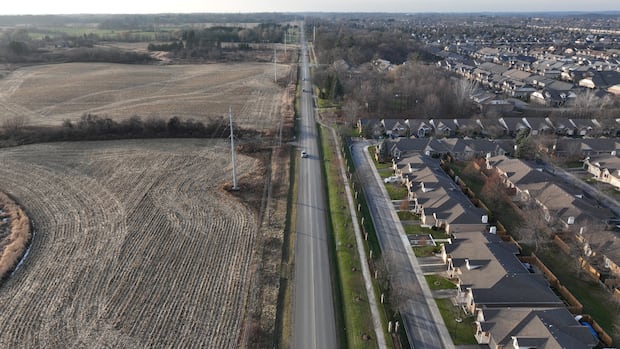
Hamilton city council has repeatedly voted-in recent years included-to uphold its current urban boundary. (Patrick Morrell/CBC)
Tribunal is ‘meddling’ with local planning, group says
Horwath told CBC Hamilton it’s inappropriate for an unelected panel to “determine the future of a municipality.”
Speaking via phone from Ottawa where she represents the city at an Association of Municipalities meeting in Ontario,
she expressed concerns that this ruling isn’t only about housing but affects broader issues like climate change and infrastructure needs. She highlighted recent flooding incidents in Hamilton along with “hundreds of millions” spent on improvements at Woodward Treatment Plant.
“What this growth into new areas does is it puts a requirement to add even more infrastructure to our responsibility.”
Councillor Mark Tadeson from Ward 11-which encompasses proposed developments-shared his disagreement with how adjudicators view this as good land use when he spoke with CBC Hamilton on Tuesday.
Tadeson acknowledged there’s certainly demand for more housing in Hamilton but felt developments shouldn’t have been bundled together like they were. He suggested gradual expansions instead rather than facing such overwhelming changes all at once as happened recently.
“I see validity in some areas,” he remarked but noted he doesn’t think prime agricultural lands like those located around Elfrida or distant sites such as White Church should have been targeted.
As far as Twenty Road W., he mentioned it was already set up for development anyway; he hopes for neighborhood growth leading towards improved walkability.
“I want to complete the community out there,” he added. p >Mark Tadeson is councilor representing ward eleven within Hamilton. (Mark Tadeson)
The advocacy organization Environmental Defence labeled this ruling an “error.”
“[The tribunal’s decision] would stifle Hamilton’s progress towards building more housing and trigger a decades-long disaster for young families hoping to stay in or move to Hamilton,” it declared through their statement.
Stop Sprawl Ham Ont-a local group opposing expansion-expressed via social media post saying they believe tribunal actions amounting “to meddling” into democracy along with local planning processes.
“It seems that local councils can vote either way concerning applications yet final decisions about land use power shifted away directly placing authority under select members appointed-through-Ford along with wealthy connected developers plus land speculators close-by him,” stated their Facebook update.
Members serving OLT receive appointment through Lieutenant Governor-in-Council indicating governance comes based upon suggestions stemming from provincial Cabinet directives.
Crowe argued within his conclusion asserting withholding property lines prioritizing aspects pertaining strictly aligned toward “local policy” such addressing climate conditions combined preserving farmland would ultimately appear inconsistent alongside what remains detailed inside [Provincial Planning Statement], referring likewise toward overall framework concerning land use managing policies effective later down in twenty twenty-four
Tadeson shared similar sentiments reflecting “difficulty comprehending how appointed officials possess greater influence determining future usage rights here over elected representatives holding seats regionally.”
“It just seems like shifting around ways bypassing our locally established authorities,” concluded Tadeson./ P >
Source link