




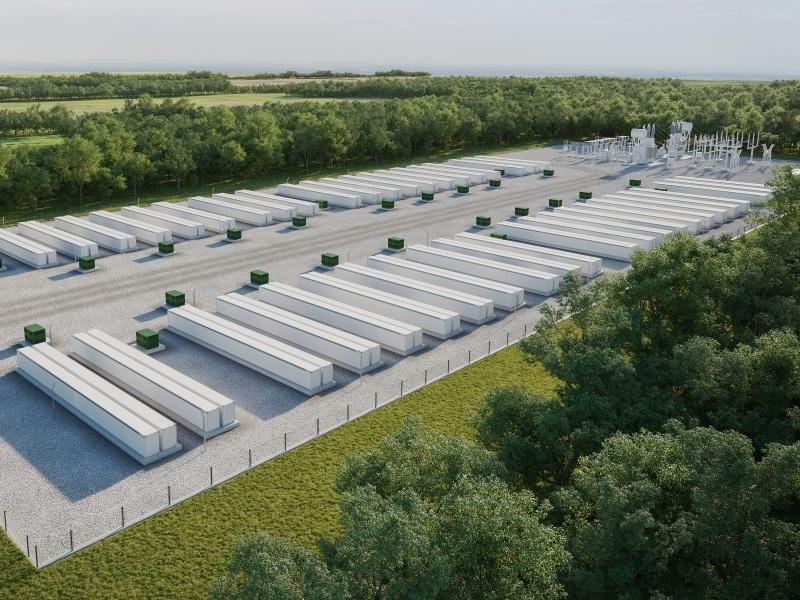
The 150-megawatt Simcoe Battery Project, rendered here, is a major energy storage asset that is slated to join the thousands of megawatts procured by Ontario’s government. (Courtesy NRStor Inc.) The team behind a battery storage facility in Simcoe County has received an award from Ontario’s electricity system manager, adding 150 megawatts (MW) of capacity to the province’s pipeline. NRStor Inc., Aecon Concessions, Sitka Power Inc., the Mississaugas of the Credit Business Corporation and the Six Nations of the Grand River Development Corporation announced they have signed a 20-year capacity contract with the Independent Electricity Systems Operator (IESO) for the Simcoe Battery Project. This project will be developed in Norfolk County – located west of Niagara Falls and east of London – and near its namesake community, with commercial operations expected to start in 2030. The five partners are working on this initiative through a jointly owned entity called Simcoe Battery Project GP Inc. Half of this asset is held by Indigenous partners, specifically the business development groups from the Six Nations of the Grand River and Mississaugas of the Credit First Nation. “It provides better, reliable electricity – a more reliable grid. It provides additional capacity and support for grid reliability,” Trevor White, president and CEO of Sitka, stated in an interview with Sustainable Biz Canada regarding the Simcoe battery energy storage system (BESS).

Batteries enhance renewable energy growth
Toronto-based NRStor is leading this project, as noted by White, while Aecon takes care of engineering, procurement and construction. Calgary-based renewable energy developer Sitka is involved in supporting long-term operations and management for this asset. The partners will provide electricity storage services to IESO through a 20-year agreement which includes payments for capacity services, energy sold to the grid and ancillary services. White chose not to disclose how much this project will cost. This development is one among three selected during the initial phase of IESO’s Long-Term 2 (LT2) capacity services request for proposals; other projects include Phase 2 of the 300 MW Napanee Battery Energy Storage System and the 190 MW Eagle Lake Power Reserve. Projects like Simcoe along with other BESS can facilitate renewable energy expansion in Ontario, according to White. Intermittent power sources such as wind and solar become more dependable when supported by energy storage solutions. “Without baseload, you require energy storage to help enable more renewables procurement onto the grid.” This initiative also helps reduce reliance on natural gas generation along with its associated greenhouse gas emissions, NRStor mentioned.Sitka also working on solar projects
The Simcoe Battery Project follows two contract awards under IESO’s LT2 energy procurement where Sitka holds ownership interests related to Timmins Mountjoy Solar and Chatsworth Solar projects. Together these projects amount to about 50 MW of solar generation capability. Like Simcoe BESS, both solar initiatives are also owned equally by Indigenous partners. Operations for these two are planned to begin around late 2028 as mentioned by White. These solar projects complement Sitka’s efforts involving solar, wind and energy storage within Ontario as stated by White. They align with their strategy aimed at boosting renewable energy growth within the province. Their current operational projects include an eight MW Gesner Wind Farm located east of Chatham along with a 10 MW David Brown Solar project near Cornwall. The three initiatives from Sitka represent over $400 million invested into clean energy infrastructure across Ontario according to company statements.BESS growth trend in Ontario
So far, Ontario has secured around 3,600 MW worth of utility-scale battery energy storage capable enough to power approximately 3.6 million homes during peak demand periods based on information released by Canadian Renewable Energy Association (Can REA) after their first LT2 procurement window back in June. The government has prioritized securing energy storage due to expectations that electricity consumption could increase by up to 75 percent before reaching year 2050 driven largely by population growth along with infrastructure electrification plus an expanding industrial sector throughout Ontario. As reported until Dec. 31st ,2025 there were only about510 MW installed overall across various forms including notable operating facilities like Oneida Energy Storage Project at250MW situated within Jarvis or York Battery Energy Storage System rated at120MW each contributing significantly towards achieving local demand needs effectively.Source link