


Unifor and General Motors have kicked off discussions for a new labour contract, starting Monday at a bargaining table in downtown Toronto.
The union represents over 4,600 members working at GM facilities in Ontario, including the Oshawa assembly plant, the CAMI facility in Ingersoll, along with operations in St. Catharines and Woodstock.
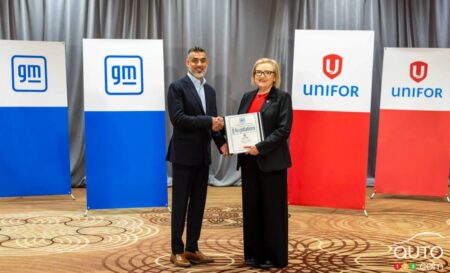
Unifor national president Lana Payne and Jack Uppal, president and managing director at GM Canada, shook hands to signify the start of their talks.
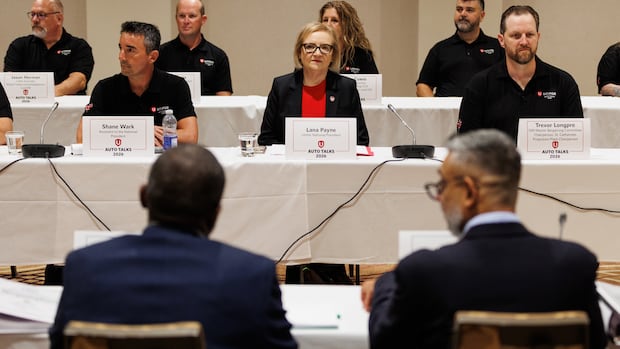
The conference room had chairs arranged where officials sat across from each other, with Payne positioned in the center of the room while Uppal was directly opposite her.
“We’re entering this next round of negotiations with the solid foundation established by the pattern agreement with Ford, and we intend to have meaningful discussions on company operations and the future of auto jobs at GM in Canada,” Payne said in a news release Monday.
The union has set an aim to finalize a tentative agreement with GM by Aug. 21.
Jack Uppal, centre left, president and managing director of GM Canada, sits alongside representatives from GM as they work towards Unifor’s target deadline of Aug. 21. (The Canadian Press)
Uppal mentioned in a news release Monday that the company approaches negotiations with “profound respect for the collective bargaining process” as well as recognizing its employees’ contribution to its success.
“Since 2020, we have invested $3.3 billion in our Canadian manufacturing plants, enabling next-generation products that will secure thousands of Canadian jobs for years to come, and our goal is to reach a mutually beneficial agreement that supports our employees while keeping GM Canada competitive for the long term,” he stated
In July, Unifor members ratified a new three-year contract with Ford that included annual pay increases of three percent.
This deal takes effect on Sept. 21 and also renewed a no-closure agreement.
Additionally, it included commitments for programs at all Ford facilities like adding a third shift at its engine plant in Essex, Ont., which is projected for 2029.
Unifor Partners with Ford on Support Program for Laid-off Workers
Unifor and Ford have also agreed to launch a program offering laid-off workers from the Oakville assembly plant pathways back to full employment by July 2027.
The union claims this agreement with Ford showcases successful pattern-setting negotiations.
Pattern bargaining involves negotiating terms with one company intending to replicate them across others within the same industry.
A total of 74 percent of Ford workers covered by this master agreement voted in favor of it while two local unions showed support rates of 97 percent and 100 percent respectively.
Unifor national president Lana Payne commented during an interview then that their deal with Ford sets an important precedent regarding wage hikes and job security.
“I have confidence in what we’ve negotiated here because history shows us if we do hit a rough patch that there’s a way to work our way through that,” Payne said at the time.
Source link
However, she recognized there are differences between Ford and other automakers like General Motors and Stellantis that might complicate upcoming negotiations.
For instance, both General Motors’ Ingersoll assembly plant and Stellantis’ Brampton assembly plant are currently inactive resulting in thousands being laid off.
“The difference is that they have taken decisions that were different than Ford Motor Co. throughout the last 18 months,” said Payne referring specifically to recent trade uncertainties Canada has faced since auto tariffs were introduced.
“There’s no doubt in my mind that those contract talks will also be tough and quite frustrating. But we have to fight for this industry here; this is one way we can do it.”
The ongoing bargaining between Unifor and Detroit’s remaining big three automakers coincides with challenges facing their sector...... The union has previously pointed out issues such as U. S tariffs imposed recently; former President Trump’s refusal extending Canada-United States-Mexico Agreement; plus increasing Chinese electric vehicle presence within Canadian markets.