


‘No single agency can manage this alone. It requires cross-agency coordination,’ official said of largest infestation of water soldier in North America
An invasive aquatic plant that can choke waterways and disrupt swimming and boating has created what officials describe as the largest infestation of its kind in North America at Lake Simcoe.
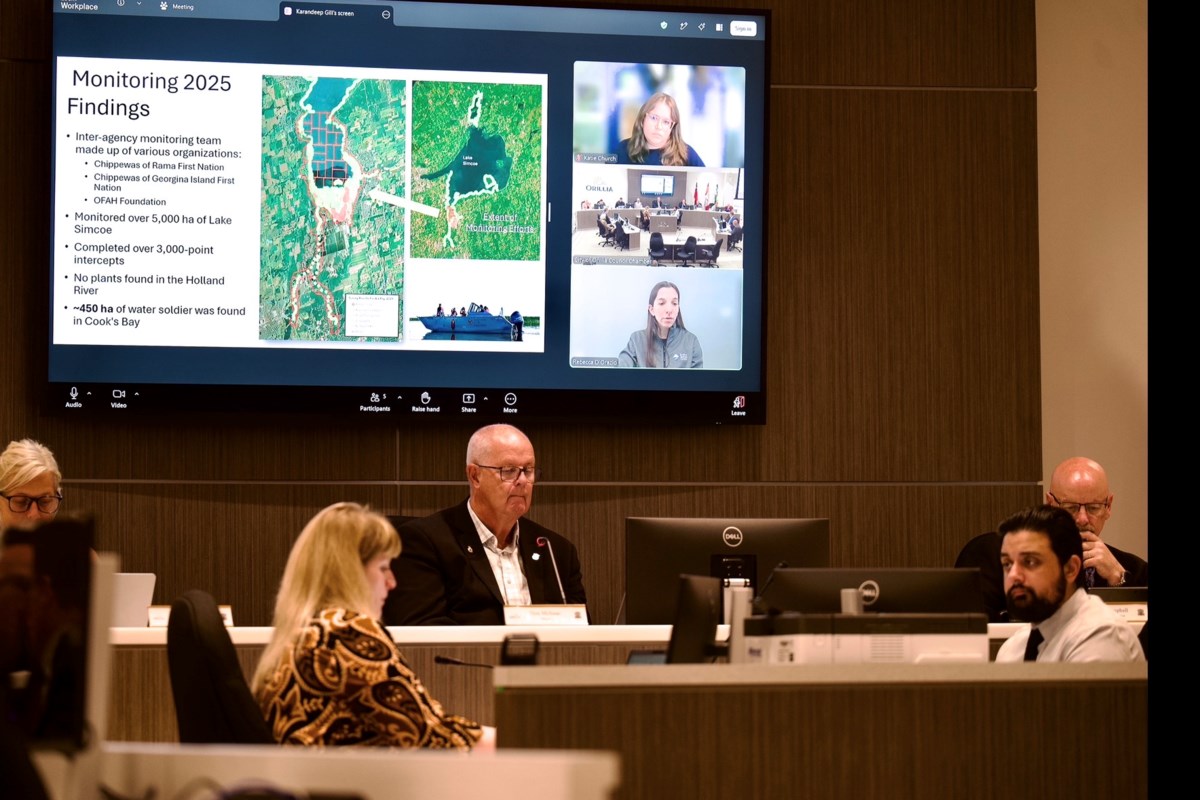
Members of the Lake Simcoe Water Soldier Working Group spoke to city council on Monday to highlight the roughly 450-hectare outbreak of water soldier found in Cook’s Bay.
Although the invasive plant hasn’t been spotted in Lake Couchiching, officials cautioned that there’s a risk it could spread beyond where it’s currently known to be.
“We are at a critical juncture,” said Katie Church, aquatic invasive plant coordinator with the Invasive Species Centre.
“The plants are contained as of 2025.. but there is a risk of spread, and that risk is only increasing.”
Water soldier is a perennial aquatic plant that grows underwater before becoming buoyant during its peak growing season in summer.
Rebecca D’Orazio, an aquatic invasive species specialist with the Invasive Species Centre, explained that this plant has sword-shaped, serrated leaves and can form large, dense colonies.
“It looks like the top of a pineapple,” she said.
This invasive species has been banned in Ontario since 2015, making it illegal to possess, transport, sell or release it.
The first detection of water soldier in Lake Simcoe occurred in 2024.
An interagency monitoring initiative surveyed over 5,000 hectares of Lake Simcoe in 2025 and confirmed that the plant remains concentrated mainly in the southern area of Cook’s Bay.
However, about 450 hectares were identified as affected.
“It’s the largest infestation in North America,” D’Orazio told council.
The presence of this plant raises both environmental and recreational concerns.
Dense colonies may displace native aquatic plants, decrease biodiversity and change habitats. They can also hinder activities like swimming, boating, fishing, water skiing and hunting for waterfowl.
The serrated leaves make navigating through or handling them difficult as well.
Even though this infestation is currently quite far from Orillia, Church emphasized that the city’s connection to both Lake Simcoe and Lake Couchiching makes preventing its spread essential locally.
“While water soldier has not been detected in Orillia, residents, boaters, anglers and other lake owners and users move between these connected waterways,” she said.
Coun. Ralph Cipolla asked if this invasive plant could eventually impact Lake Couchiching.
Church responded by saying monitoring done there in 2025 found no water soldier present; they continue monitoring Lake Couchiching this year as well.
“As of right now, it’s not in Lake Couchiching,” she said.
The working group is developing a management strategy to tackle the Cook’s Bay infestation with an estimated treatment budget of $5 million over five years.
Church noted that an issue this significant can’t be handled with just one method alone.
Possible solutions include mechanical harvesting, manually pulling plants from smaller infestations or using herbicides for larger groups.
The group is also implementing a pilot management project this year while expanding surveillance into other parts of Lake Simcoe.
Coun. Jay Fallis asked whether water soldier could affect drinking water quality sourced from either Lake Simcoe or Lake Couchiching.
Officials indicated previous infestations hadn’t impacted water quality; however, the unprecedented size of Cook’s Bay’s infestation brings some uncertainty.
“We don’t really know what that looks like in the fall when those plants die back and there’s all this biomass,” Church said.
This summer’s work includes conducting tests on water quality.
The presentation aimed mainly to inform council but encouraged Orillia’s participation within the Lake Simcoe Water Soldier Working Group.
“No single agency can manage this alone,” she stated. “It requires cross-agency coordination.” p >
Source link