


I’ve been thinking a lot about feelings of insecurity lately.
Partly because I’m trying to understand what our work on the precarity mindset really reveals. The more time I spend analyzing the data, the more it seems clear that we need to expand our perspective on insecurity and how it influences political views and actions.
If you’re genuinely having a tough time making ends meet or if you’ve recently lost your job, there’s a real worry there.
But for others, like those who own their home but have a hefty mortgage, or those who just retired, what looks like stability from an outside viewpoint might not feel so secure when they look inward.
There’s this unease about what the future holds.
Will your job still be available in a few years?
Will rent or mortgage payments remain manageable?
Will your relationships stand the test of time?
Will the life you’ve worked hard for still resemble what it is today?
This gap between perception and reality is at the heart of a new study by Abacus Data that we’re sharing today called The Security Spectrum.
I believe it sheds light on something significant happening in Canadian politics right now.
In July, we surveyed 2,705 Canadian adults asking them how secure they feel across six key areas: basic needs, finances, safety and health, belonging, respect and recognition, as well as purpose and growth.
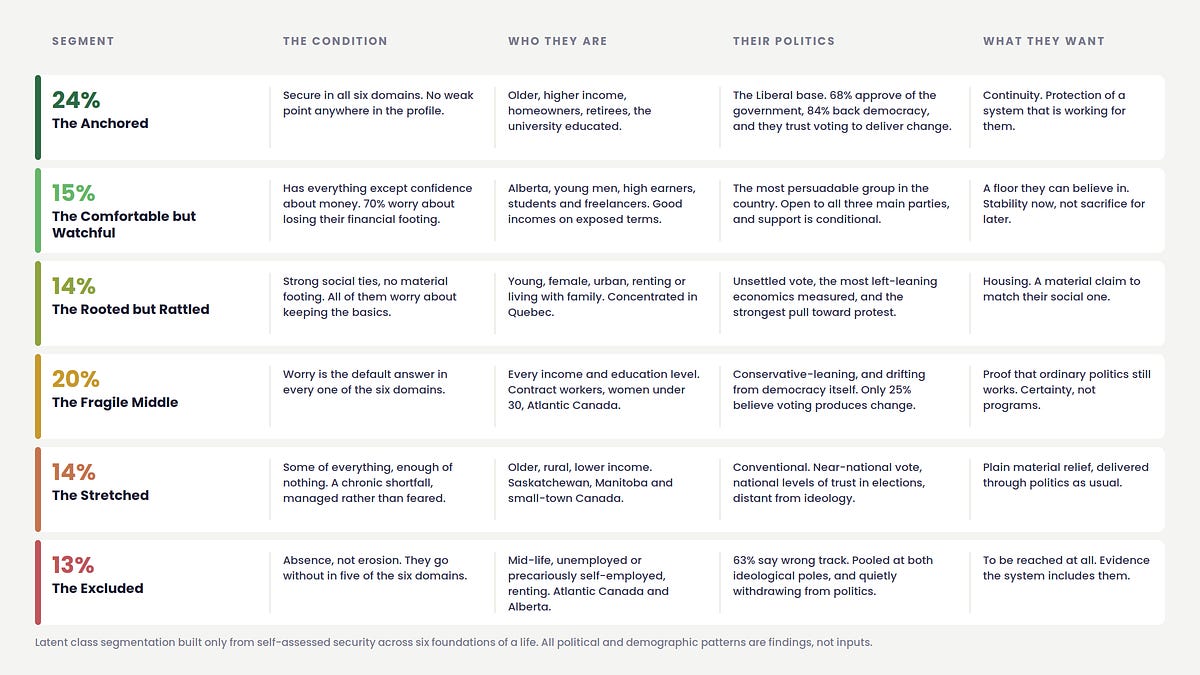
When I ran a segmentation analysis based on those responses, six distinct groups surfaced. Some showed clear differences while others had subtler nuances.
The Anchored group feels secure in nearly all aspects of their lives.
The Comfortable but Watchful are generally doing well; however, there’s some underlying financial anxiety beneath that sense of stability.
The Rooted but Rattled experience social connection and security within their relationships but face material vulnerabilities.
The Fragile Middle have most of what they need today but are uncertain about keeping it tomorrow.
The Stretched consistently feel they lack sufficient resources.
Lastly, there are the Excluded, who lack many foundational aspects altogether.
You can visualize these groups as a ladder-ranging from the most secure to the least. One would think political opinions and behaviors would become increasingly unstable as you descend this ladder.
However, that’s not exactly what we observe.
One reason I find this research useful for understanding consumers’, workers’, and voters’ mindsets today is that how much insecurity someone faces may be less important politically than what kind of insecurity they’re experiencing.
Let me illustrate this by comparing two groups: the Stretched and the Fragile Middle.
The Stretched are worse off regarding most material measures. They struggle with financial security; possess fewer resources; and encounter ongoing shortfalls. So naturally one might think they’d be more detached from politics than others.
But they don’t express that sentiment to us.
Their voting patterns closely resemble those of Canadians overall while their trust in democracy remains relatively strong. Most seem to believe elections can actually lead to meaningful changes.
The Fragile Middle tell a different story though.
This group represents roughly one-fifth of Canadians-and importantly-they aren’t solely found among low-income individuals. We see them across almost all income brackets.
If they’re not facing severe material deprivation , then what’s setting them apart?
It’s their belief that what they currently have could vanish tomorrow.
This expectation leads to deeper political unrest.
A mere 25% of those in the Fragile Middle think real change occurs through voting or standard political processes.
Only 45% assert democracy is always better than other government forms.
A significant portion-over one-third-believes there could be situations where non-democratic governance might seem preferable.
These distinctions are striking because they imply that political ramifications stemming from insecurity aren’t merely about lacking resources.
This group fears losing what’s already been built-which indicates a different psychological state altogether. P >
If you merge together both groups-the Fragile Middle alongside another cohort-the Rooted but Rattled-you end up with around one-third of Canadians whose sense of insecurity mainly stems from worrying about losing established assets like jobs , homes , pensions , living standards , status , or an overall sense of security they’ve come to expect over time.
When examining deeper motivations driving these people politically , it’s evident they’re not solely pursuing chaos or vast societal shifts.
Often times , they’re seeking something simpler: reassurance.
They want assurance that they’ll remain stable on solid ground moving forward. That adds layers to their political leanings.
Take affordability as an example.
For some individuals , affordability resonates as “I’m struggling right now & I need assistance.”
For another person , it signifies “I’m managing okay presently ; yet I’m anxious I’ll falter soon enough ; please help protect my achievements.”
Conversely for yet another individual again -affordability becomes shorthand for something broader: “the system no longer serves folks like me.”
Politically speaking , we usually lump all three perspectives into one category.
We refer to this phenomenon simply as affordability – economic anxiety- or cost-of-living pressures.
However I suspect these diverse viewpoints don’t align perfectly with each other nor convey identical requests.
Each represents unique demands originating from various insecurities which may necessitate distinct types offers politically.
As I continue working through this analysis, the subtlety surrounding these differences sheds considerable light upon contemporary public opinion trends along with factors steering our politics.
Download the Report